


| Issue |
Wuhan Univ. J. Nat. Sci.
Volume 30, Number 2, April 2025
|
|
|---|---|---|
| Page(s) | 133 - 138 | |
| DOI | https://doi.org/10.1051/wujns/2025302133 | |
| Published online | 16 May 2025 | |
Mathematics
CLC number: O153.3
Absolutely Clean N-Complexes
绝对Clean N-复形
College of Mathematics and Computer Science, Northwest Minzu University, Lanzhou 730030, Gansu, China
† Corresponding author. E-mail: This email address is being protected from spambots. You need JavaScript enabled to view it.
Received:
10
April
2024
Abstract
The notion of absolutely clean N-complexes is studied. We show that an N-complex  is absolutely clean if and only if
  is N-exact and
  is an absolutely clean module for each
  and
and  In particular, we prove that a bounded above N-complex
  is absolutely clean if and only if
  is an absolutely clean module for each
  . We also show that under certain hypotheses, an N-complex
  is Gorenstein AC-injective if and only if
  is a Gorenstein AC-injective module for each
  and
and  .
.
摘要
研究了绝对clean N-复形的概念,证明了N-复形 是绝对clean的当且仅当
 是N-正合的并且对任意的
 和
和 ,
, 是绝对clean模。特别地,证明了上有界N-复形
 是绝对clean的当且仅当
 是N-正合的并且对任意的
 ,
, 是绝对clean 模。证明了一定条件下N-复形
 是Gorenstein AC-内射的当且仅当对任意的
 和
和 ,
, 是Gorenstein AC-内射模。
Key words: absolutely clean module / absolutely clean N-complex / Gorenstein AC-injective N-complex
关键字 : 绝对clean模 / 绝对clean N-复形 / Gorenstein AC-内射N-复形
Cite this article: HAN Xia, WANG Xin, LU Bo. Absolutely Clean N-Complexes[J]. Wuhan Univ J of Nat Sci, 2025, 30(2): 133-138.
Biography: HAN Xia, female, Master candidate, research direction: homological algebra. E-mail: This email address is being protected from spambots. You need JavaScript enabled to view it.
Foundation item: Supported by the National Natural Science Foundation of China (12061061), Fundamental Research Funds for the Central Universities (31920230173), Longyuan Young Talents of Gansu Province, and Young Talents Team Project of Gansu Province (2025QNTD49)
© Wuhan University 2025
 This is an Open Access article distributed under the terms of the Creative Commons Attribution License (https://creativecommons.org/licenses/by/4.0), which permits unrestricted use, distribution, and reproduction in any medium, provided the original work is properly cited.
0 Introduction
A module  is called type
  if
if  has a projective resolution by finitely generated projective modules. This concept is a generalization of finitely generated modules and finitely presented modules, which is studied by Bravo et al[1]. Also a module
  is called
  -injective or absolutely clean if
 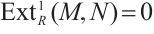 for all modules
  of type
  , these modules have properties that injective modules only have over Noetherian rings. Specifically, if
  is left Noetherian, the modules of type
  are precisely the finitely generated modules.
The category of complexes plays an important role in the theory of homological algebra, and many results of the category of modules have been generalized to the category of complexes. As we know, in the category of complexes, the relationship between complexes and its level modules and cycle modules is an important research topic. For example, a complex is injective if and only if it is exact and each cycle module is injective. A complex  is absolutely clean if and only if
  is exact and each
  is an absolutely clean module for each
  and
and  . A complex
  is Gorenstein AC-injective if and only if
  is a Gorenstein AC-injective module and
 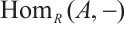 is exact for any absolutely clean complex
  [2].
[2].
The notion of N-complexes was introduced by Mayer in his study of simplicial complexes[3-4], that is, it satisfies differentials  . The category of N-complexes is consistent with the category of complexes whenever
  . In 1996, Kapranov[5], Dubois-Violette and Kerner[6] gave an abstract framework of homological theory of N-complexes. Since then, the N-complexes have been concerned by many authors, for example Refs.[7-11]. Recently, Lu[12] introduced the concept of FP-injective N-complexes, which has shown that an N-complex
  is FP-injective if and only if
  is N-exact and
  is an FP-injective module for each
  and
and  .
.
In present paper, we establish relationships between the absolutely clean N-complex and its level modules and cycle modules. And from this, we prove that under certain hypotheses, an N-complex  is Gorenstein AC-injective if and only if
  is a Gorenstein AC-injective module for each
  and
and  .
.
More precisely, our results can be stated as follows:
Theorem 1 Let  be an N-complex. Then
  is absolutely clean if and only if
  is N-exact and
  is an absolutely clean module for each
  and
and .
.
As an application of Theorem 1, the following result is established.
Proposition 1 Let  be a bounded above N-complex. Then
  is absolutely clean if and only if
  is N-exact and
  is an absolutely clean module for
  .
.
It is well known that an N-complex  is Gorenstein AC-injective if and only if
  is a Gorenstein AC-injective module and
 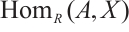 is N-exact for any absolutely clean N-complex
  [9]. As another application of Theorem 1, we also obtain the following result, which extends the above classical result to the Gorenstein AC-injective N-complexes.
Proposition 2 Let  be an N-exact N-complex with
  N-exact for any absolutely clean module
  . Then
  is a Gorenstein AC-injective N-complex if and only if
  is a Gorenstein AC-injective module for each
  and
and  .
.
1 Preliminaries
Throughout this paper, unless stated otherwise,  denotes an associative ring with an identity and by the term "module" we always mean a left
  -module and use
  -
- to denote the category of left
  -modules.
This section is devoted to recalling some notions and basic consequences for use throughout this paper. For terminology we shall follow Refs. [7] and [10] when working with N-complexes.
By an N-complex  we mean a sequence of left
  -modules

satisfying  for any
  . That is, composing any N-consecutive morphisms gives
  . So a
  -complex is a chain complex in the usual sense. A chain map or simply map
  of N-complexes is a collection of morphisms
 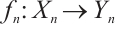 making all the rectangles commute. In this way, we get a category of N-complexes of left
  -modules, denoted by
  , whose objects are N-complexes and whose morphisms are chain maps. This is an abelian category having enough projectives and injectives. Let
  and
and  be N-complexes. We use
  to denote the Abelian group of morphisms from
  and
and  and
and 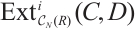 for
for  to denote the groups we get from the right derived functor of
  .
.
For an N-complex  , there are
  choices for homology. Indeed for
  , we define
  and
and  . In particular, we have
 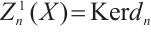 ,
,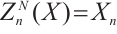 and
and 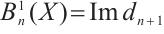 ,
,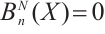 . Finally, we define
  the amplitude homology objects of
  for all
  . We say
  is N-exact, or just exact, if
 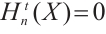 for all
  and
and  .
.
An N-complex  is called bounded, if there is only a finite number
  such that
  ; if
; if  when
when  is sufficiently large, which is called bounded above. Similarly, we can define lower bounded N-complexes. As we know, an N-complex
  is called finitely generated if
  is bounded and
  is a finitely generated module for each
  .
.
Unless stated otherwise, in the following complexes will always denote  -complexes. Given a module
  , we define N-complexes
  for
for  , as follows:
  consists of
  in degrees
  , all joined by identity morphisms, and
  in every other degree. Let
 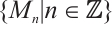 be objects of modules. Then
  for all
  . Therefore,

Two chain maps  are called chain homotopic, or simply homotopic if there exists a collection of morphisms
  such that
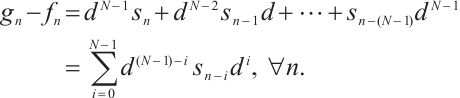 (1)
(1)
If  and
and  are homotopic, then we write
  . We call a chain map
  null homotopic if
  . There exists an additive category
  , called the homotopy category of N-complexes, whose objects are the same as those of
  and whose
  sets are the equivalence classes of
  sets in
  . An isomorphism in
  is called a homotopy equivalence. Let
  be the collection of sequences
  of morphisms in
  such that
  is split exact in
  for any integer
  .
.
Following Ref.[8], let 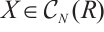 , we have morphisms
  and
and  . Set
. Set  and
and 
 . Then we have the following exact sequences in
  ,
,
 (2)
(2)
and
 (3)
(3)
Now we define functors  ,
, by
by  and
and  in the exact sequences above. Then
  and
and  induce the suspension functor and its quasi-inverse of the triangulated category
  . On the other hand, we define the shift functor
  by
by 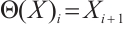 and
and 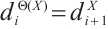 for
for  . The N-complex
  is denoted as
  and inductively we define
  for all
  . This induces the shift functor
  which is a triangle functor. Unlike classical case,
  does not coincide with
  .
.
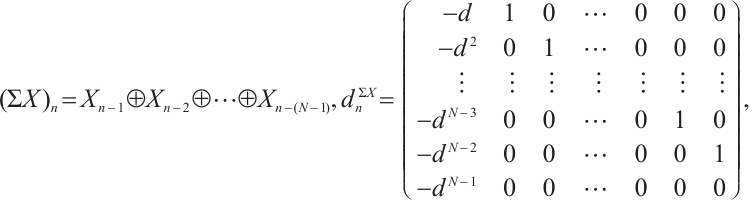
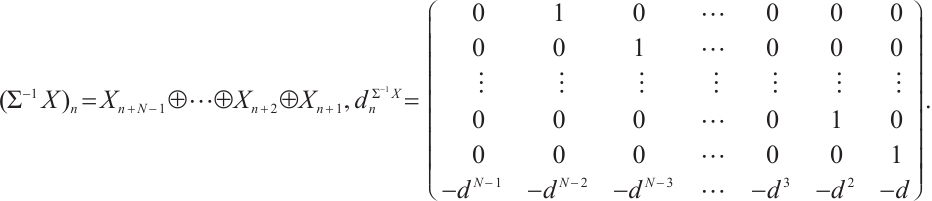
Following Refs. [8] or [10], for any N-complex  ,
,  and
and  are given by the following explicit description,
2 Main Results
In this section, we investigate the concept of absolutely clean N-complexes and give some equivalence characterizations of absolutely clean N-complexes. In particular, we prove that an N-complex  is absolutely clean if and only if
  is N-exact and
  is an absolutely clean module for each
  and
and  .
.
Definition 1 An N-complex  is of type
  if
if  has a projective resolution
  by finitely generated projective N-complexes
  for
for  .
.
Proposition 3 An N-complex  is of type
  if and only if it is bounded and each
  is a module of type
  .
.
Proof Sufficiency. Let  be of type
  . Then it must be finitely generated, so it is bounded. We also see that each N-complex
  must consist of finitely generated projective modules in each degree by the definition of N-complex of type
  . So we get that each
  is a module of type
  .
.
Necessity. Suppose  is bounded and each
  is a module of type
  , we can construct a surjection
 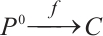 where
where  is a finitely generated projective N-complex. Set
 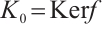 and note that it also must be bounded. Since each
  must also be finitely presented, it follows that each
  is finitely generated. Thus
  is finitely generated, and we can again construct a surjection
 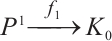 where
where  is a finitely generated projective N-complex. Set
 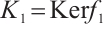 and note that
  must be bounded. Since each
  must be of type
  , it follows that
  must also be finitely generated N-complex. Continuing this way, we can construct a projective resolution
 (4)
(4)
where each  is a finitely generated projective N-complex.
Remark 1 1) If  is a module of type
  , then
  is an N-complex of type
  for each
  and
and  .
.
2) An N-complex of type  is finitely generated.
Definition 2 An N-complex  is said to be absolutely clean if
  for all N-complexes
  of type
  .
.
Remark 2 1) If  , then absolutely clean N-complexes are precisely absolutely clean complex.
2) The class of absolutely clean N-complexes is closed under direct products, summands and direct limits.
3)  is absolutely clean for any absolutely clean N-complex
  and
and  .
.
4) The class of absolutely clean N-complexes is coresolving. For any absolutely clean N-complex  and
and  of type
  , we have
  for all
  .
.
5) The class of absolutely clean N-complexes is closed under clean N-subcomplexes and clean quotients.
It is well known that an N-complex  is injective if and only if
  is N-exact and
  is an injective module for each
  and
and  . In the following, we will generalize this characterization to the absolutely clean N-complexes. Firstly, we need to make the following preparations.
Lemma 1 An N-complex  is absolutely clean if and only if
  for all modules
  of type
  and
and  and
and  .
.
Proof Sufficiency. It is trivial.
Necessity. Without losing generality, we take  has the following form:
 (5)
(5)
with each  a module of type
  for
for  .
.
For any  , we put
 (6)
(6)
Then  . In the following, we prove the result by using induction on
  . For
. For  , by the assumption,
 . Assume that
  . Applying the functor
  to the exact sequence
 (7)
(7)
yields the following exact sequence
 (8)
(8)
Then  , as desired.
Lemma 2[11] Let  -
- ,
, 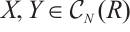 and
and  ,
, . Then we have the following natural isomorphisms:
1)  .
.
2)  .
.
3)  .
.
4) .
.
5)  .
.
6)  .
.
7) If  is N-exact, then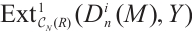
 .
.
8) If  is N-exact, then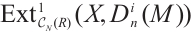
 .
.
Following Ref. [5], let  and
and  be N-complexes of left
  -modules. We will denote by
 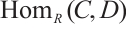 the sequence of Abelian groups with
  and such that if
  then
then  , where
  is a N-th root of unity,
  and
and  . Then
  is also an N-complex.
  is called a chain map of degree
  if
if  . A chain map of degree
  is called a morphism.
Lemma 3[13] Let  and
and  be N-complexes. Then
  . In particular,
 is N-exact if and only if
  , i.e.,
 is equivalent to
  for
for  and
and  .
.
Proof of Theorem 1
Sufficiency. Let  be an absolutely clean N-complex. Then
  for any module
  of type
  ,
,  and
and  . This implies that N-complex
  is N-exact[13]. Note that
  is of type
  . It follows that
  must be an N-exact N-complex. Also,
  for all modules
  of type
  ,
,  and
and  . Using Lemma 2, we get
  is an absolutely clean module for
  and
and  .
.
Necessity. It follows by Lemma 1 and Lemma 2.
Then the following result can be obtained by Theorem 1.
Corollary 1 If an N-complex  is absolutely clean, then
  is an absolutely clean module for each
  and
and  . Moreover,
 is an absolutely clean module for each
  .
.
Corollary 2 A module  is absolutely clean if and only if the N-complex
  is absolutely clean for each
  and
and  .
.
In the following, we obtain a result for bounded above N-complex  .
.
Proof of Proposition 1
Sufficiency. Obviously,  is N-exact and
  is an absolutely clean module for
  by Theorem 1 and Corollary 1.
Necessity. Assume that  has the following form:
 (9)
(9)
Since  is N-exact,
 (10)
(10)
This implies that 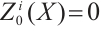 for
for  and
and 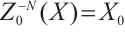 . Also we have
 (11)
(11)
Then 
Similarly, 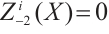 for
for  and
and


 (12)
(12)
Then  is absolutely clean for
  ,
,  .
.
Note that




 (13)
(13)
are exact. This implies that  is absolutely clean for
  .
.
Using exact sequences




 (14)
(14)
we can obtain  is absolutely clean for
  .
.
We also obtain  is absolutely clean for
  ,
, , by a similar method. Thus
  is absolutely clean by Theorem 1.
As we know, absolutely clean N-complex is important for the characterization of Gorenstein AC-injective N-complexes. An N-complex  is Gorenstein AC-injective if and only if
  is a Gorenstein AC-injective module and
 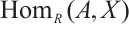 is N-exact for any absolutely clean N-complex
  [9]. Next we obtain an equivalent characterization for N-exact absolutely clean N-complex in Gorenstein AC-injective N-complexes.
Proof of Proposition 2
Sufficiency. From the definition of the Gorenstein AC-injective N-complexes[8], there is an exact sequence of injective N-complexes
 (15)
(15)
with 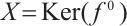 and which remains exact after applying
  for any absolutely clean N-complex
  . Since
 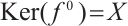 and
and  are N-exact, we have
  is N-exact for all
  .
.
For the exact sequence
 (16)
(16)
according to Ref. [14] we have the following exact sequence
 (17)
(17)
Thus there is an exact sequence of injective modules
 (18)
(18)
with  . Next we only show that
 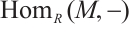 applying the sequence (18) exact for any absolutely clean module
  .
.
Let  be an absolutely clean module and
 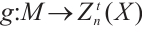 be a morphism of modules. Since
  is N-exact, there exists a morphism
 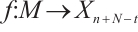 such that the following diagram commute (Fig. 1).
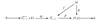 |
Fig. 1 The commutative diagram of  Note that |



 (19)
(19)
It follows from Lemma 2
 (20)
(20)
is exact. Similarly, we can prove that
 (21)
(21)
is exact. Hence, 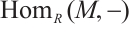 applying the sequence (18) exact.
Necessity. Note that there is an exact sequence
 (22)
(22)
and 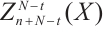 and
and  are Gorenstein AC-injective modules, this implies
  is a Gorenstein AC-injective module for each
  . Next we need to prove that
 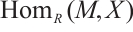 is N-exact for any absolutely clean N-complex
  . The proof is similar to Theorem 3.2 in Ref. [2]. Thus
  is a Gorenstein AC-injective N-complex.
References
- Bravo D, Gillespie J, Hovey M. The stable module category of a general ring[EB/OL]. [2014-06-25]. https://arxiv.org/abs/q-alg/1405.5768. [Google Scholar]
- Bravo D, Gillespie J. Absolutely clean, level, and Gorenstein AC-injective complexes[J]. Communications in Algebra, 2016, 44(5): 2213-2233. [Google Scholar]
- Mayer W. A new homology theory I[J]. Annals of Mathematics, 1942, 43(2): 370-380. [Google Scholar]
- Mayer W. A new homology theory II[J]. Annals of Mathematics, 1942, 43(3): 594-605. [Google Scholar]
- Kapranov M M. On the q-analog of homological algebra[EB/OL]. [1996-11-04]. https://arxiv.org/abs/q-alg/9611005. [Google Scholar]
- Dubois-Violette M, Kerner R. Universal q-dierential calculus and q-analog of homological algebra[EB/OL]. [1996-08-30]. https://arxiv.org/abs/q-alg/9608026. [Google Scholar]
- Gillespie J. The homotopy category of N-complexes is a homotopy category[J]. Journal of Homotopy and Related Structures, 2015, 10(1): 93-106. [Google Scholar]
- Iyama O, Kato K, Miyachi J I. Derived categories of N-complexes[J]. Journal of the London Mathematical Society, 2017, 96(3): 687-716. [Google Scholar]
- Lu B. Gorenstein objects in the category of N-complexes[J]. Journal of Algebra and Its Applications, 2021, 20(10): 2150174. [CrossRef] [Google Scholar]
- Yang X Y, Ding N Q. The homotopy category and derived category of N-complexes[J]. Journal of Algebra, 2015, 426: 430-476. [Google Scholar]
-
Yang X Y, Gao T Y. Cotorsion pairs in
 [J]. Algebra Colloquium, 2017, 24(4): 577-602.
[Google Scholar]
[J]. Algebra Colloquium, 2017, 24(4): 577-602.
[Google Scholar]
- Lu B. FP-injective objective in the category of N-complexes[J]. Indian Journal of Pure and Applied Mathematics, 2024, 55(1): 242-255. [Google Scholar]
- Lu B, Di Z X. Gorenstein cohomology of N-complexes[J]. Journal of Algebra and Its Applications, 2020, 19(9): 2050174. [Google Scholar]
- Lu B. Cartan-Eilenberg Gorenstein projective N-complexes[J]. Communications in Algebra, 2021, 49(9): 3810-3824. [Google Scholar]
All Figures
|
Fig. 1 The commutative diagram of Note that |
| In the text | |
Current usage metrics show cumulative count of Article Views (full-text article views including HTML views, PDF and ePub downloads, according to the available data) and Abstracts Views on Vision4Press platform.
Data correspond to usage on the plateform after 2015. The current usage metrics is available 48-96 hours after online publication and is updated daily on week days.
Initial download of the metrics may take a while.