


| Issue |
Wuhan Univ. J. Nat. Sci.
Volume 31, Number 3, June 2026
|
|
|---|---|---|
| Page(s) | 255 - 262 | |
| DOI | https://doi.org/10.1051/wujns/2026313255 | |
| Published online | 24 June 2026 | |
Mathematics
CLC number: O17
On Sufficient Conditions for the Exchangeability of Limits and Norms
极限与范数可交换性的若干充分条件研究
1
School of Mathematics and Statistics, Liupanshui Normal University, Liupanshui 553000, Guizhou, China
(六盘水师范学院 数学与统计学院,贵州 六盘水 553000)
2
School of Big Data, Baoshan University, Baoshan 678000, Yunnan, China
(保山学院 大数据学院,云南 保山 678000)
3
School of Mathematics and Physics, Jinggangshan University, Ji'an 343009, Jiangxi, China
(井冈山大学 数理学院,江西 吉安 343009)
† Corresponding author. E-mail: This email address is being protected from spambots. You need JavaScript enabled to view it.
Received:
11
September
2024
Abstract
In the field of mathematical analysis, the Monotone Convergence Theorem (MCT), Fatou's lemma, and the Dominated Convergence Theorem (DCT) play a crucial role in the study of the interchangeability of limits and integrals (or norms). Among them, the DCT when applied to series of numbers, namely Tannery's theorem, has been explored to a certain extent. However, the MCT and Fatou's lemma related to series of numbers still lack in-depth research in existing literature. This paper proposes and proves Fatou's lemma and the MCT in  space. By constructing counterexamples, it demonstrates that the DCT does not hold in
  space. In the research of series of numbers, this paper uses the property of the infimum of real numbers to prove Fatou's lemma for series of numbers. Taking this as a theoretical foundation, it further derives the MCT and the DCT related to series of numbers. Through an in-depth analysis of the logical relationships among these three theorems, an equivalence relation among them is established, and their application values in practical problems are demonstrated through examples. In addition, based on the theory of abstract measure and integration, the proofs of the three theorems related to series of numbers are provided. It is particularly worth noting that the classical Fatou's lemma and the MCT usually require that the corresponding sequence of functions satisfies the prerequisite of being non-negative and measurable. However, Fatou's lemma and the MCT in
  space no longer impose the non-negativity requirement on the sequence of functions. This characteristic may have potential application prospects.
摘要
在数学分析领域,单调收敛定理(MCT)、法图引理及控制收敛定理(DCT)在极限与积分(或范数)的可交换性研究中占据关键地位。其中,控制收敛定理应用于数项级数时的特定版本,即Tannery定理,已得到一定探讨;然而,与之相关的数项级数单调收敛定理及法图引理,在现有文献中缺乏深入研究。本文提出并证明了 空间下的法图引理与单调收敛定理。通过构造反例,论证了控制收敛定理在
 空间中不成立。在数项级数研究方面,本文运用实数下确界的性质,证明了数项级数的法图引理,并以此为基础,进一步推导得出与数项级数相关的单调收敛定理与Tannery定理。本文分析三者之间的逻辑关联,建立起这三个定理的等价关系,并通过实例展示其在实际问题中的应用。此外,基于抽象测度与积分理论,本文还给出了基于数项级数的这三个定理的证明。特别地,经典法图引理与单调收敛定理通常要求相应函数列满足非负可测的前提条件。而
 空间下的法图引理与单调收敛定理突破了这一限制,不再对函数列施加非负性要求。这一特性可能有潜在应用前景。
Key words: series of numbers / interchanging limits and norms / monotone convergence theorem / Fatou's lemma / dominated convergence theorem
关键字 : 数项级数 / 极限与范数的交换 / 单调收敛定理 / 法图引理 / 控制收敛定理
Cite this article: YI Hua, CHEN Yong, DAI Yinyun. On Sufficient Conditions for the Exchangeability of
Biography: YI Hua, male, Associate professor, research direction: wavelet analysis and applications. E-mail: This email address is being protected from spambots. You need JavaScript enabled to view it.
Foundation item: Supported by the National Natural Science Foundation of China (12461029), the High Level Talent Research Project of Liupanshui Normal University (LPSSYKYJJ202416) and the Doctoral Research Startup Fund of Jinggangshan University (JZB2014)
© Wuhan University 2026
 This is an Open Access article distributed under the terms of the Creative Commons Attribution License (https://creativecommons.org/licenses/by/4.0), which permits unrestricted use, distribution, and reproduction in any medium, provided the original work is properly cited.
0 Introduction
It is a well-known fact that every absolutely convergent series in a scalar field  (where
  is commonly
  or
or  ) converges[1]. To be specific,
 (1)
(1)
always holds by the continuity of  and the triangle inequality, where
  . However,
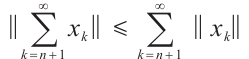 (2)
(2)
may not necessarily hold (see (19) for example) in a normed vector space  , where
  may be a function, and
  may indicate convergence almost everywhere or point wise. Put differently, this normed vector space is endowed with two topologies[2]: one is induced by the norm, and the other by the point-wise convergence of vector sequences. When the two topologies in question coincide, it becomes a reasonable and intuitive step to interchange the order of taking limits and norms. This is because norms exhibit continuity with respect to this topology. However, as indicated in Ref. [3], these two topologies may be distinct. Thus, interchanging the order of limits and norms necessitates the employment of additional methods or tools.
In many practical applications, the question of whether limits and integrals commute frequently arises. For instance, when establishing limit distributions, if the sequence of probability density functions  corresponding to the sequence of random variables
  converges to a certain function, namely
  , the question arises as to whether
  for all Borel sets
  [4].
[4].
In this article, several sufficient conditions that make equation (2) hold in  space are studied. Generally, the Monotone Convergence Theorem (MCT), Fatou's lemma, and the Dominated Convergence Theorem (DCT) provide sufficient conditions for interchanging limits and integrals (or norms).
In fact, the MCT, Fatou's lemma and the DCT for abstract measure space have wide applications in many fields, such as for random elements in convex combination spaces[5], in statistical convergence[6]. Moreover, Fatou's lemma in several dimensions[7], in a separable Banach space[8], in infinite-dimensional spaces[9] have also been studied. On the contrary, Tannery's theorem for series of numbers is really a special case of Weierstrass M-test or the DCT, which is why it probably doesn't get much attention[10-11]. Meanwhile, the MCT and Fatou's lemma related to series of numbers have been rarely studied in literature, and their corresponding proofs and applications have not been systematically studied. The three theorems for series of numbers, serving as the theoretical basis for interchanging limits and 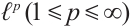 norms, deserve more attention.
Generally, the MCT is firstly proved, and then to prove Fatou's lemma by the MCT both for abstract measure space[12] and for series of numbers[13]. In the following text, we first show that the sum of the infimum is less than the infimum of the sum in real number field. If these elements involved in summing are non-negative, then Fatou's lemma for series of numbers can be obtained. If we replace the sum in Fatou's lemma and the MCT with supremum, we obtain Fatou's lemma and the MCT for  space. We also provide examples of strict inequality in Fatou's lemma. Furthermore, we obtain the manifestations of Fatou's lemma in
  spaces. And then we prove the MCT for series of numbers and Tannery's theorem by Fatou's lemma for series of numbers. Then we prove the equivalent relationships among Fatou's lemma, the MCT and Tannery's theorem for series of numbers.
We present applications of these theorems. In 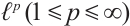 space, we have demonstrated that series that are absolutely convergent is also convergent. This proves the completeness of these function spaces. In the proof process, we have repeatedly utilized the technique of exchanging limits and norms. Specifically, we use the MCT to prove that the series which is absolutely convergence is in
 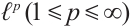 . Moreover, we use the MCT for
  and
and  , and Tannery's theorem for
  to prove that the series which is absolutely convergence converges in the
  norm. The application of Fatou's lemma also involves proving the completeness of
  spaces. For a Cauchy sequence in these function spaces, we first identify the potential limit sequence. Subsequently, by applying Fatou's lemma, we prove that this limit sequence is indeed an element of the space. Additionally, we demonstrate that the Cauchy sequence converges to this limit sequence in the
  norm.
norm.
The paper is organized as follows. In Section 1, Fatou's lemma for series of numbers and for  , the MCT for series of numbers and for
  are analyzed. We also give the equivalent relationships of Fatou's lemma, the MCT and Tannery's theorem for series of numbers. In Section 2.1, we provide the applications of the MCT for series of numbers and
  , along with those of Tannery's theorem. In Section 2.2, we provide the applications of Fatou's lemma for series of numbers and
  . In Section 3, we demonstrate that the DCT for
  is not valid by providing a counterexample. In Section 4, the proofs of the three theorems for series of numbers based on the abstract measure and integration are also provided. In Section 5, we give conclusions of this paper.
1 Theorems for Series of Numbers and  Space
Space
Definition 1 Let  denote the real field and
  the set of natural numbers. The set
  of all sequences of elements of
  is a vector space for component-wise addition and component-wise scalar multiplication. If
  ,
,  is the subspace of
  consisting of all sequences
 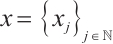 satisfying
 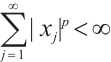 . The real-valued function
  is defined by

If  , then
  is defined to be the space of all bounded sequences endowed with the norm

Lemma 1 Suppose  is a sequence of real numbers. Then for any
  , we have
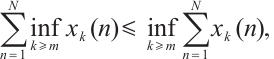 (3)
(3)
and
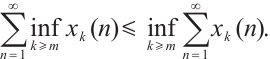 (4)
(4)
Proof It is obvious that

Thus

Thus, (3) is derived by taking the infimum with respect to  on both side of the above inequality. (4) can be obtained in a similar manner.
Remark 1 If the condition of non-negative for  is added to this lemma, Fatou's lemma can be obtained.
Theorem 1 (Fatou's lemma for series of numbers[13]). Suppose 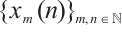 is a sequence of nonnegative real numbers (i.e.,
  for each
  ). Then
 (5)
(5)
Proof If  , we have
 (6)
(6)
by the non-decreasing property of the partial sum sequence of positive series with respect to the number of terms.
By virtue of equations (3) and (6), along with the transitive nature of inequalities, we can derive
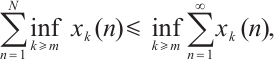 (7)
(7)
We take the limit as  on both sides of equation (7). By invoking the property that allows us to exchange the order of the limit and the finite-summation, we obtain
 (8)
(8)
Letting  on both sides of (8), and noting that
  is just the
  , we have (5).
Theorem 2 (Fatou's lemma for  space). Suppose
  is a sequence of real numbers. Prove that
 (9)
(9)
Proof It is obvious that

Thus

Remark 2 In Theorems 2 (Fatou's lemma for  space) and 4 (the MCT for
  space), it's not necessary for
  to be non-negative. But in applications of this paper, we only encounter non-negative situations.
The following Example 1 illustrates that equations (3), (5) and (9) can obtain strict inequality.
Example 1 Let
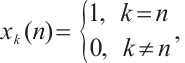
where  . Then

and 
Corollary 1 (The manifestations of Fatou's lemma in  spaces). Suppose
 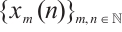 is a sequence, where
  . We have
 (10)
(10)
and
 (11)
(11)
provided all expressions that appeared in the above two inequalities are meaningful.
Proof 

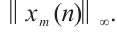
The inequality in the above equation is due to (9).


The inequality in the above equation is due to (5).
Remark 3 If the condition

is added in Fatou's lemma, the inequality in Fatou's lemma will become the equality in the MCT.
Theorem 3 (the MCT for series of numbers[13]). Suppose that  is a sequence of nonnegative real numbers (i.e.,
  for each
  ). Suppose that
 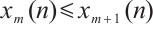 for each
  . Set
. Set 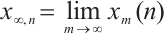 . Thus
 (12)
(12)
Proof By Fatou's lemma, we have
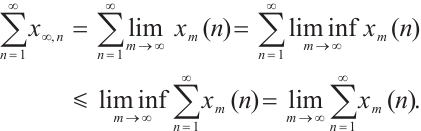 (13)
(13)
Since  , we have
  . Thus
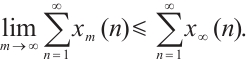 (14)
(14)
By (13) and (14), we have (12).
Corollary 2 The MCT and Fatou's lemma for series of numbers are equivalent to each other, that is, they can be proven to each other.
Proof Theorem 3 illustrates that the MCT can be proved by Fatou's lemma. We direct the reader to Ref. [13] for the proof demonstrating that Fatou's lemma can be established through the MCT for numerical series.
Theorem 4 (the MCT for  space). Suppose that
 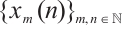 is a sequence of real numbers. Suppose that
  . Set
. Set  . Prove that
 (15)
(15)
Proof By (9), we have

Since  , the
, the  in the above inequality can be written as
  . That is

Conversely, we are required to establish inequality in the opposite direction. Since  , we have
  . Thus

Then (15) is obtained.
Theorem 5 (The DCT for series of numbers known as Tannery's theorem[10-11]). Suppose that  is a sequence of real numbers.
  , and
, and 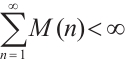 , then
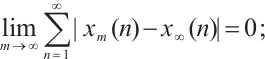 (16)
(16)
and
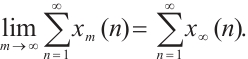 (17)
(17)
We will prove Tannery's theorem by using Fatou's lemma. The proof without Fatou's lemma and the MCT can be found in Refs. [10-11].
Proof Since  and
and 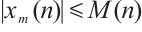 , we have that
  . Thus
  . By Theorem 4, we have


Subtracting 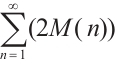 from both sides of this inequality yields

Thus

Since  , the left-hand side of the above-mentioned inequality equals
  . Thus
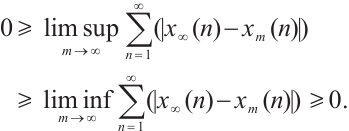
Thus, (16) is proved. (17) can be obtained by (16) immediately.
Corollary 3 Fatou's lemma for series of numbers can be proved by Tannery's theorem provided that
 (18)
(18)
Proof It is obvious that  . By (18) and Tannery's theorem, we have

By (4), we have
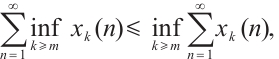
and

Thus,

Theorem 6 A normed vector space  is complete if and only if every absolutely convergent series in
  converges[12,14].
This theorem will be used to prove Example 2.
2 Applications
2.1 Applications of the MCT and the DCT
Example 2 Prove that every absolutely convergent series in 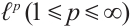 converges. Thus
  are complete.
Proof We use Theorem 6. Suppose  where
where  Let
Let  by the triangle inequality of
  norm, and
  . We claim
  and
and 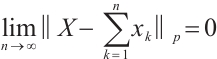 . Thus, the series
  converges in the
  norm.
norm.
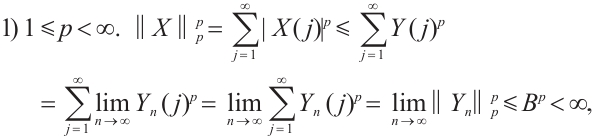
where the third equality is due to the MCT for series of numbers. Thus  . By the DCT for series of numbers and
  , we have
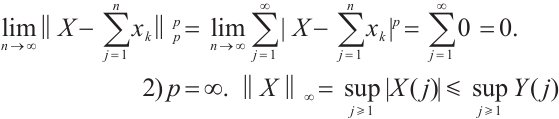
 , where the third equality is due to the MCT for
  . Thus
  . Since
 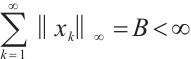 , we have
  . If we can prove
 (19)
(19)
then we can obtain 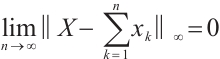 . In fact,
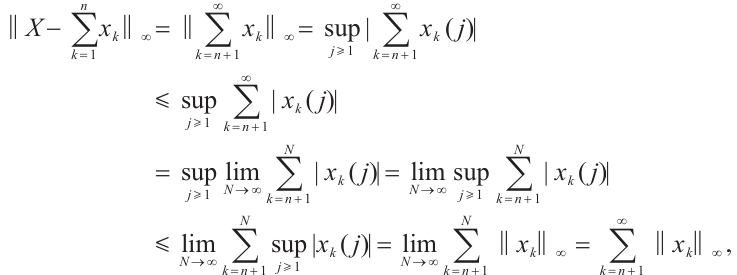
where the fourth equality is due to the MCT for  . Thus, (19) is proved.
In the above proof process, when  , we use Tannery's theorem to prove that this series converges in the
  norm. When
  , we used the MCT to prove that this series converges in the
  norm. It is worth noting that when
  , the MCT can also be used to prove that this series converges in the
  norm. It suffices to prove (2). The proof process is as follows.
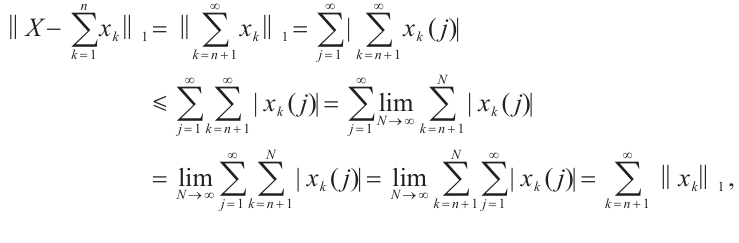
where the fourth equality is due to the MCT for series of numbers. Thus (2) is proved. Usually, the completeness of  can be proved by using the DCT [12]. However, as pointed out here, the completeness of
  can also be proved without the DCT by using the MCT.
2.2 Applications of Fatou's Lemma
Example 3 Prove that every Cauchy sequence in 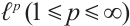 converges. Thus
 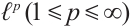 are complete.
Claim 1 Each Cauchy sequence in 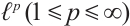 converges point wise. In fact, if
  is a Cauchy sequence in
  , where
 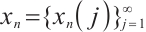 . According to the definition of Cauchy sequence, we have that
  such that
 (20)
(20)
Since 

for each  . That is for each fixed
  ,
, 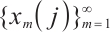 is a Cauchy sequence. By the completeness of the field
  , there exists a
  such that

for each  . We will prove that
  in the next step.
Claim 2 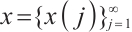 is in
is in 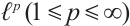 . For
. For  , there exists
  such that
 (21)
(21)
1)  . By (21), we have

By (11), we have  That is to say that
  . Thus
  is in
is in  since
since 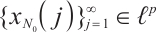 and
and  is closed for addition.
2)  . By (21), we have

By (10), we have  That is to say that
  . Thus
  is in
is in  since
since 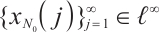 and
and  is closed for addition.
Claim 3  converges to
 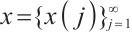 in the norm of
  . Since
  is a Cauchy sequence in
  , we have that
  such that
 (22)
(22)
Case 1  . By (22), we have that

By (11), we have 
In short,  . Thus
  converges to
  in the norm of
  .
.
Case 2  . By (22), we have that

By (10), we have 
In short,  . Thus
  converges to
  in the norm of
  .
.
Thus 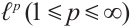 are complete.
3 Discussion
We have introduced Fatou's lemma and the MCT for  . So, is there a dominated convergence theorem for
  ?
?
We will derive a proposition in  by analogy with the DCT. Subsequently, we will demonstrate the falsity of this proposition by constructing a counterexample.
Proposition 1 Suppose that 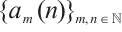 is a real number sequence,
  for each
  . There exists a
  , such that
 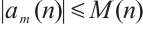 . Then
 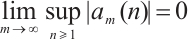 .
.
Example 3 Consider an infinite dimensional matrix composed of  :
:
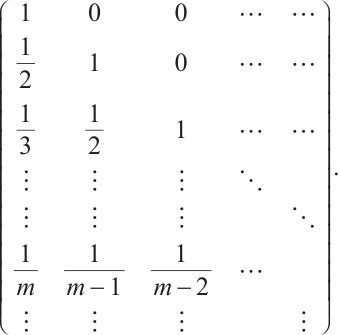
It is easy to verify that 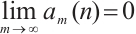 for each
  , and there exists a
  with
with  , such that
 (23)
(23)
However,  . Thus Proposition 1 is false. In other words,
 (24)
(24)
even though (23) is valid. Equation (24) provides us with an example where the order of limit and norm cannot be swapped.
4 Proofs of Three Theorems for Series of Numbers Based on the Abstract Measure and Integration
Usually, the general term of a positive series  is nonnegative. Here we can assume that its general term can take positive infinity. That is
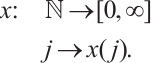 (25)
(25)
Define the measure space 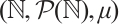 , where
  is the power set of
  , and
, and  is the counting measure defined by
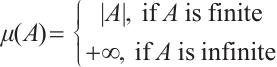
for all  , where
  denotes the cardinality of the set
  . In this case, the function defined in (25) is measurable, and

Then

By the MCT of abstract integral and the fact that 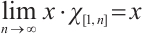 , the left-hand side of the above equality is just
  . Thus
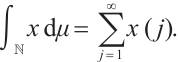
Hence, Fatou's lemma and the MCT for series of numbers are inherently valid, since positive series are expressible as Lebesgue integrals in the context of abstract measure spaces. Nevertheless, series with conditional convergence cannot be treated as Lebesgue integrals. This is because Lebesgue integrability implies absolute integrability; that is, a function is considered Lebesgue-integrable if and only if its absolute value is also Lebesgue-integrable. Fortunately, the proof process of the DCT for series of numbers only requires the use of Fatou's lemma for the positive series and the linear properties of the convergent series.
The following is a proof of Theorem 5 by using Fatou's lemma for the abstract measure and integration.
Proof Since  , we have that
  . Thus

Thus, 

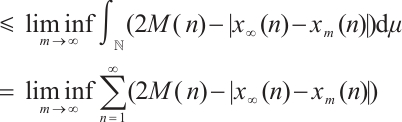

Subtracting 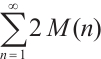 from both sides of this inequality yields

Thus


Thus, (16) is obtained.
5 Conclusion
In this work, Fatou's lemma and the MCT for  space are proposed and proved. Moreover, we systematically analyze the interrelationships of Fatou's lemma, the MCT and Tannery's theorem for series of numbers, revealing the underlying theoretical links among these important results. We also found some applications for these theorems in
 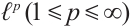 spaces. It should be noted that in Example 2, where the MCT is applied, Fatou's lemma can also be used instead. Finding the applications of these theorems is the next research direction.
References
- Rudin W. Principles of Mathematical Analysis[M]. Beijing: China Machine Press, 2019. [Google Scholar]
- Conway J B. A Course in Functional Analysis[M]. New York: Springer-Verlag, 1990. [Google Scholar]
- Rudin W. Functional Analysis[M]. New York: McGraw-Hill Publishing Co., 1991. [Google Scholar]
- Scheffe H. A useful convergence theorem for probability distributions[J]. The Annals of Mathematical Statistics, 1947, 18(3): 434-438. [Google Scholar]
- Alonso de la Fuente M, Terán P. Convergence theorems for random elements in convex combination spaces[J]. Fuzzy Sets and Systems, 2023, 458: 69-93. [Google Scholar]
- Tunc T, Erdem A. A note on convergence theorems for integrals[J]. Miskolc Mathematical Notes, 2021, 22(2): 1001-1011. [Google Scholar]
- Schmeidler D. Fatou's lemma in several dimensions[J]. Proceedings of the American Mathematical Society, 1970, 24(2): 300-306. [Google Scholar]
- Khan M A, Majumdar M. Weak sequential convergence in L1(μ, X) and an approximate version of Fatou's Lemma[J]. Journal of Mathematical Analysis and Applications, 1986, 114(2): 569-573. [Google Scholar]
- Yannelis N C. Fatou's lemma in infinite-dimensional spaces[J]. Proceedings of the American Mathematical Society, 1988, 102(2): 303. [Google Scholar]
- Loya P. Amazing and Aesthetic Aspects of Analysis[M]. New York: Springer-Verlag, 2017. [Google Scholar]
- Johnston D, Kayll P M, Palmer C. Deranged matchings: Proofs and conjectures[J]. The American Mathematical Monthly, 2024, 131(2): 95-111. [Google Scholar]
- Folland G B. Real Analysis: Modern Techniques and Their Applications[M]. New York: Wiley-Interscience, 2007. [Google Scholar]
- Frazier M W. An Introduction to Wavelets Through Linear Algebra[M]. New York: Springer-Verlag, 1999. [Google Scholar]
- Megginson R. An Introduction to Banach Space Theory[M]. New York: Springer-Verlag, 1998. [Google Scholar]
Current usage metrics show cumulative count of Article Views (full-text article views including HTML views, PDF and ePub downloads, according to the available data) and Abstracts Views on Vision4Press platform.
Data correspond to usage on the plateform after 2015. The current usage metrics is available 48-96 hours after online publication and is updated daily on week days.
Initial download of the metrics may take a while.