


| Issue |
Wuhan Univ. J. Nat. Sci.
Volume 31, Number 3, June 2026
|
|
|---|---|---|
| Page(s) | 263 - 268 | |
| DOI | https://doi.org/10.1051/wujns/2026313263 | |
| Published online | 24 June 2026 | |
Mathematics
CLC number: O152.5
Presenting Little q-Schur Superalgebra uk(2|1,3)
小q-Schur超代数 uk(2|1,3)的展示
College of Mathematics and Physics, China Three Gorges University, Yichang 443002, Hubei, China
(三峡大学 数理学院,湖北 宜昌 443002)
E-mail: This email address is being protected from spambots. You need JavaScript enabled to view it.
Received:
18
February
2025
Abstract
The purpose of this paper is to investigate the generators and relations for little q-Schur superalgebra  . The basis of
  is obtained through the Poincaré-Birkhoff-Witt (PBW) basis of q-Schur superalgebra
  , then we present a new set for generators and relations for
  by PBW basis.
摘要
本文研究小q-Schur超代数 的生成元与关系式。由q-Schur超代数
 的Poincaré-Birkhoff-Witt(PBW)基得到了小q-Schur超代数
 的基,并由此给出了小q-Schur超代数
 一组新的生成元与关系式。
Key words: q-Schur superalgebra / little q-Schur superalgebra / Poincaré-Birkhoff-Witt (PBW) basis / generators and relations
关键字 : q-Schur超代数 / 小q-Schur超代数 / Poincaré-Birkhoff-Witt(PBW)基 / 生成元与关系式
Cite this article: GE Xiaoxue, ZHANG Li. Presenting Little q-Schur Superalgebra uk(21,3)[J]. Wuhan Univ J of Nat Sci, 2026, 31(3): 263-268.
Biography: GE Xiaoxue, female, Master candidate, research direction: algebraic groups, quantum groups. E-mail: This email address is being protected from spambots. You need JavaScript enabled to view it.
Foundation item: Supported by the Natural Research Project of Yichang(A23-026)
© Wuhan University 2026
 This is an Open Access article distributed under the terms of the Creative Commons Attribution License (https://creativecommons.org/licenses/by/4.0), which permits unrestricted use, distribution, and reproduction in any medium, provided the original work is properly cited.
0 Introduction
Let  be the q-Schur algebras over
  introduced by Dipper and James[1-2], who have showed that q-Schur algebras play an important role in the investigation of presentation theory of the finite general linear groups. The presentation of the q-Schur algebras could be referred to Refs. [3-4]. Gao and Liu[5] gave a set of primitives for the center of q-Schur algebras
  . Du et al[6] studied the representation of little q-Schur algebra and gave a classification of finite representations of little q-Schur algebras under odd unit roots. And they pointed out that there is no nice and simple presentation for
  . Then, Bian and Liu[7] gave the presentation of little q-Schur algebras
  .
.
Little q-Schur superalgebras have been an important approach to studying q-Schur superalgebras. Turkey and Kujawa[8] gave a presentation of the Schur superalgebra and its quantum analogue. Chen[9] generalized algebra and quantum supergroup to the infinitesimal case, and finally obtained the infinitesimal theory of q-Schur superalgebras and the Beilinson-Lusztig-MacPherson (BLM) realization of integral quantum supergroups. Then, on one hand, we want to get deep understanding of the structure of the little q-Schur superalgebra  by investigating the representation of
  in this paper; on the other hand, since little q-Schur superalgebras are closely related to q-Schur superalgebras, the research results on
  may be generalized to the study of more general little q-Schur superalgebras and even q-Schur superalgebras.
This paper studies the generators and relations for little q-Schur superalgebra  .We briefly recall the definitions of q-Schur superalgebras
 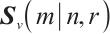 in Section 1. In Section 2, we prove that the set
  is the basis of
  and present the generators and relations of
  .
.
1 Preliminary
In the case of superalgebras, define a parity function, a mapping  , on the set
  , for any
  , there is

Note  is the quantum enveloping superalgebra of the Lie superalgebra
  [10]. Let
  . As a vector space,
  is the set of
  by
by  matrices. For
  , we set
  to be the matrix unit with a 1 in
  -th row and
  -th column. Then the set of matrix units forms a homogeneous basis for
  . The degree of
  is
is  . For any
 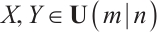 ,
,  is the parity of
  , and the square bracket
  is the super-Lie bracket, it means
  . From now on, we mark
  for convenience.
Definition 1[8] The quantum supergroup  is generated by the elements

subject to the following relations:
(Q1)  ;
;
(Q2) 
(Q3)  ;
;
(Q4)
(Q5) if  ,
,




(Q6)
Let v be an indeterminate and 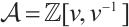 , and Gauss symmetric polynomials will be introduced here . For any integers
  , let
, let 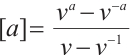 ,
, 
and  . For any integers
  and
and  ,
, , we write
  and define the root vectors in
  as follows. If
  , then set
  ,
,  . For
. For  , inductively set
  ,
,  . Besides for short, let
 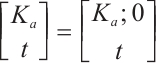 . Specializing
  to
to  ,
, will be viewed as an
  -module. When
  is specialized to
  ,
,  ,
,  and
and  specialize to
  ,
, and
and  . And we define
  .
.
Theorem 1[8] The q-Schur superalgebras  are generated by the elements

subject to the following relations:
(Q1)-(Q6) in Definition 1.
(Q7)
(Q8) 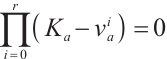 ,
,  .
.
By Theorem 1, we can obtain the algebraic full homomorphism  , such that there is
 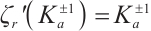 ,
,  ,
, for
for  and
and  .
.
Theorem 2[11] There is an algebra homomorphism  satisfying

where  (1 in position a).
Lemma 1[9] 1) The set  is the orthogonal idempotent set of
 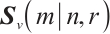 ;
;
2) For any  and
and  ,
,  .
.
Theorem 3[12] For all  , the set
 forms a
  (q)-basis for q-Schur superalgebras
  .
.
Let  and
and  , define

Let  be the set of all
  such that
  for all
  and
and  be the set of all
  whose diagonal entries are zero. According to Theorem 1, the following results can be obtained.
Lemma 2[8] For 
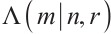 and
and 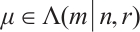 , we have
1)  ;
;
2) 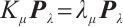 , where
  ;
;
3)  .
.
Proposition 1[9] For 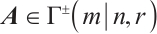 ,
,
1) If there exist  for all
  and
and  , then
 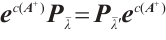 , where
  ; otherwise,
 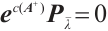 ;
;
2) If there exist  for all
  and
and  , then
 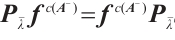 , where
  ; otherwise,
  , where
  and
and  denote the column sum and row sum of the matrix
  , respectively.
2 The Little q-Schur Superalgebra 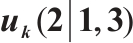
Let  be the subalgebra of
  which is generated by all
  ,
,  .
.
According to (Q2),  (
( ) is the central element of
  (and therefore also
  ). Let
  be the ideal generated by
  (
( ) in
) in  and
and  .
.
Thus quotient (super) algebra  is called
  infinitesimal quantum supergroup. The image of
  under
under  is denoted as
 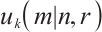 .
. 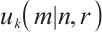 is called little q-Schur superalgebra related to
  ,
,  ,
,  and
and  .
.
Theorem 4 The set

3,  forms a basis for
  .
.
Proof Fix 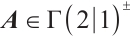 satisfying
  for all
  . By the definition of
  , we have

In the q-Schur superalgebra  , for any
 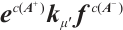 , if
, if  for some
  , then it lies in the span of
  in Theorem 3. Then we have

By Theorem 3, the elements above are linearly independent, thus the set  is linearly independent.
Inspired by Ref. [8], we have the following commutation formulas in the  .
.
Proposition 2 For  ,
, ,
,  , we define:

(2.1a)  ;
;
(2.1b)  ;
;
(2.1c)  ;
;
(2.1d)  ;
;
(2.1e)  ;
;
(2.1f) 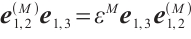 ;
;
(2.1g)  .
.
Proof For (2.1a), by  .The equation holds.
For (2.1b), we can obtain  by
by
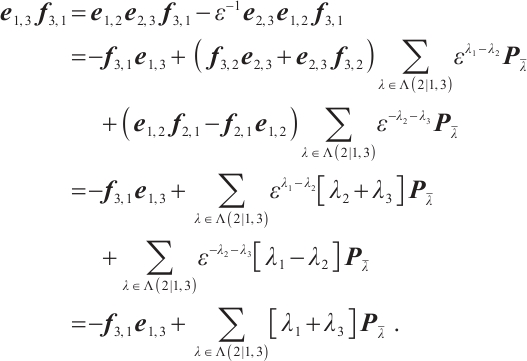
For (2.1c), in order to prove 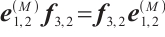 , we need following steps:
Step 1 When  ,we can easily prove
 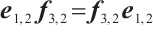 .
.
Step 2 When  , we assume
 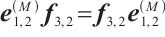 holds, then we will discuss the following situation:
For (2.1d), we can obtain  by (2.1c)

For (2.1e), in order to prove  , we need the following steps:
Step 3 When  ,we can prove
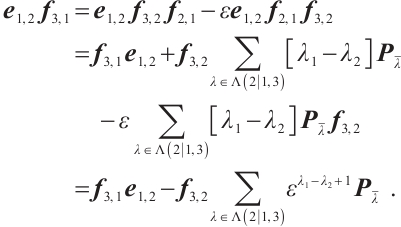
Step 4 When  , we assume
  holds, then we will discuss the following situation:
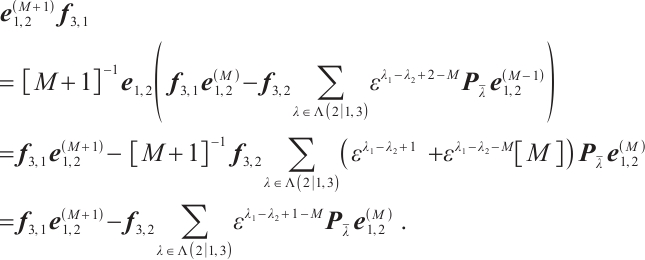
For (2.1f, 2.1g), the proof is similar to the above.
Theorem 5 The algebra  is generated by the elements
 , subject to the following relations:
 when
when  ;
;
 ;
;
 ;
;
 when
when  ;
;
 when
when  ;
;
 when
when  ;
;

 ;
;

 ;
;

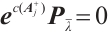 (resp.
 ) for
) for  (resp.
  ) and
) and  satisfying that if

The key to prove Theorem 5 is that in  , the relation
  holds.
Proposition 3 In little q-Schur superalgebra  , we have
 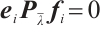 .
.
If  and
and  .
.
Proof 
From the above conclusions, it can be seen that little q-Schur superalgebra  satisfies the relation
  of Theorem 5.
We define an algebra  which satisfies the generators and relations given in Theorem 5. Set
  (resp.
  ,
, ) be the subalgebra generated by
  (resp.
  ,
,  ). For
  , we give the root vectors in the same way, which satisfy the commutation formulas (2.1a)-(2.1g). According to the relations (LR3)-(LR7) in Theorem 5, we know that
  can be spanned by all the elements
  ,
,  .
.
Proposition 4 The set

 is a spanning set for
  .
.
Proof Fixing 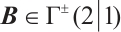 , to prove this proposition, it suffices to show that if
 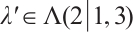 with
with  , satisfying
  for some
  , then
  lies in the span of
  . Here
  is a linear combination of the elements in
  and
and 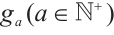 is a constant.
Case 1 If 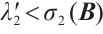 and
and  , assuming
  . For
. For  , we only need to consider
 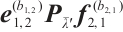 .
.
By Theorem 5  , when
  (or
(or  ),
),  (or
(or  ) is a linear combination of the elements in
  .Then we consider
  , where
  .
.
Case 1-1 If  and
and 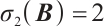 , for
, for  ,
,
1) When  , by Theorem 5
  ,
,

where  is a linear combination of the elements in
  .
.
2) When  , by Theorem 5
  , we can obtain
  .
.
Case 1-2 If  and
and 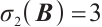 , for
, for 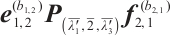 , where
  , by Theorem 5
  ,
,

Then,
1) When  ,
,

2) When  , by Theorem 5
  , we can obtain

where  and
and  are linear combinations of the elements in
  .
.
For  , when
  , the proof is similar to the above.
Case 1-3 If  and
and 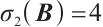 , for
, for  ,
,
When  (or
(or  ), by Theorem 5
  , we can obtain
  .
.
When 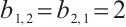 , by Theorem 5
  ,
,
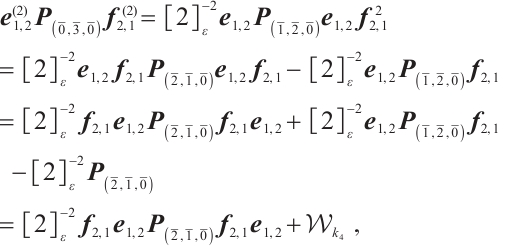
where  is a linear combination of the elements in
  .
.
Case 2 If  and
and  , assuming
  , for
, for 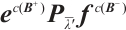 , by the commutation formulas (2.1a), (2.1f) , we have

where  is a linear combination of the elements in
  .Therefore, we only need to consider
  .
.
By Theorem 5  , when
 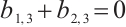 (or
(or  ),
), 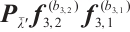 (or
(or 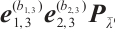 ) is a linear combination of the elements in
  . We consider
  , where
  and
and 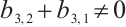 .
.
Case 2-1 If  and
and 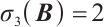 , we need to consider
  ,
,
When 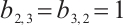 , for
, for  ,
,
1) When  , by Theorem 5
  ,
,

where  is a linear combination of the elements in
  .
.
2) When  , by Theorem 5
  , we can obtain
  .
.
When 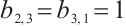 , for
, for 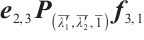 ,
,
1) When  , by Theorem 5 (LR3, LR9) and the commutation formulas (2.1c),

where  is a linear combination of the elements in
  .
.
2) When  , by Theorem 5
  ,
,
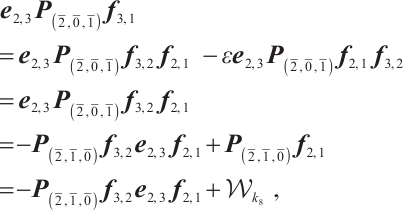
where  is a linear combination of the elements in
  .
.
When 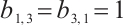 , for
, for  ,
,
1) When  , by the commutation formulas (2.1b), we have
  ,
,
where  is a linear combination of the elements in
  .
.
2) When  , by theorem 5
  and the commutation formulas (2.1d), we have
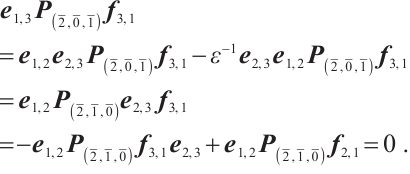
For  , when
 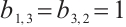 , the proof is similar to the above.
Case 2-2 If  and
and 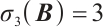 , for
, for 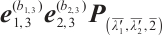
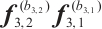 , when
  , for
, for 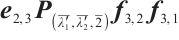 ,by Theorem 5
  and the commutation formulas (2.1d),
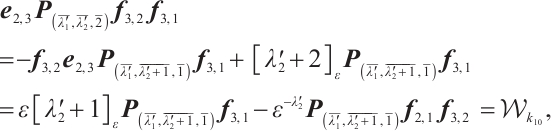
where  is a linear combination of the elements in
  .
.
When  , by the commutation formulas (2.1b , 2.1d ), we have
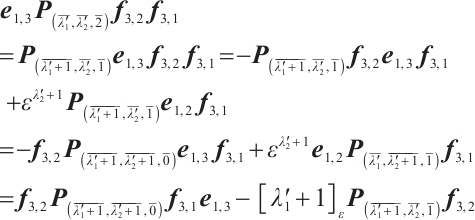

where  is a linear combination of the elements in
  .
.
For  , when
  and
and  , the proof is similar to the above.
Case 2-3 If  and
and 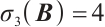 ,we need to consider
  , by Theorem 5 (
 ,
,  ) and the commutation formulas (2.1b , 2.1d ), we have
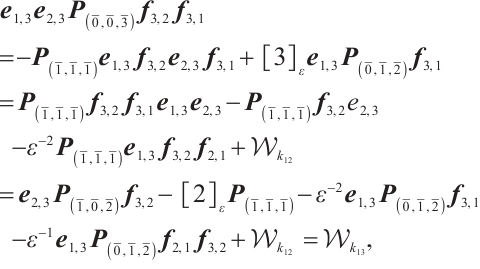
where  and
and  are the linear combination of the elements in
  . We complete the proof of Proposition 4.
Proof of Theorem 5 By the definition of  and Theorem 1, it is clear that
  satisfies the relations (Q1-Q6) in Definition 1. Hence, there is a surjective algebra homomorphism from
  to
to  . On the basis of Theorem 3, Propositions 1 and 4, we have the
  that satisfies the relations in Theorem 5. According to the definition of
  , there is a surjective algebra homomorphism
  from
from  to
to  satisfying
  ,
,  ,
,  . On the other hand, by Proposition 1, we see that the map
  sends the spanning set of
  to the basis of
  . Hence
  is an isomorphism.
References
- Dipper R, James G. The q-Schur algebra[J]. Proceedings of the London Mathematical Society, 1989, s3-59(1): 23-50. [Google Scholar]
- Dipper R, James G. Q-tensor space and q-Weyl modules[J]. Transactions of the American Mathematical Society, 1991, 327(1): 251-282. [MathSciNet] [Google Scholar]
- Doty S, Giaquinto A. Presenting Schur algebras[J]. International Mathematics Research Notices, 2002, 2002(36): 1907-1944. [Google Scholar]
- Du J, Parshall B. Monomial bases for q-Schur algebras[J]. Transactions of the American Mathematical Society, 2003, 355(4): 1593-1620. [MathSciNet] [Google Scholar]
- Gao W T, Liu M Q. The center of q-Schur algebra U(2, r)[J]. Communications in Algebra, 2021, 49(12): 5031-5040. [Google Scholar]
- Du J, Fu Q, Wang J P. Representations of little q-Schur algebras[J]. Pacific Journal of Mathematics, 2012, 257(2): 343-378. [CrossRef] [MathSciNet] [Google Scholar]
- Bian Z H, Liu M Q. Presenting little q-Schur algebras uk(2; r)[J]. Algebra Colloquium, 2017, 24(2): 297-308. [CrossRef] [MathSciNet] [Google Scholar]
- El Turkey H, Kujawa J. Presenting schur superalgebras[J]. Pacific Journal of Mathematics, 2013, 262(2): 285-316. [Google Scholar]
- Chen X Y. The Infinitesimal Theory of q-Schur Superalgebra and the BLM Implementation of Integer Quantum Supergroup[D]. Shanghai: East China Normal University, 2014(Ch). [Google Scholar]
- Zhang R B. Finite dimensional irreducible representations of the quantum supergroup[J]. Journal of Mathematical Physics, 1993, 34(3): 1236-1254. [Google Scholar]
- Du J, Gu H X. A realization of the quantum supergroup[J]. Journal of Algebra, 2014, 404: 60-99. [Google Scholar]
- Du J, Rui H B. Quantum Schur superalgebras and Kazhdan-lusztig combinatorics[J]. Journal of Pure and Applied Algebra, 2011, 215(11): 2715-2737. [Google Scholar]
Current usage metrics show cumulative count of Article Views (full-text article views including HTML views, PDF and ePub downloads, according to the available data) and Abstracts Views on Vision4Press platform.
Data correspond to usage on the plateform after 2015. The current usage metrics is available 48-96 hours after online publication and is updated daily on week days.
Initial download of the metrics may take a while.