


| Issue |
Wuhan Univ. J. Nat. Sci.
Volume 31, Number 3, June 2026
|
|
|---|---|---|
| Page(s) | 281 - 290 | |
| DOI | https://doi.org/10.1051/wujns/2026313281 | |
| Published online | 24 June 2026 | |
Mathematics
CLC number: O175.29
Existence of Ground State Solutions to Nonlinear Schrödinger-Poisson System with Doping Profile and Coercive Potential
含掺杂分布与强制势的非线性薛定谔-泊松系统基态解的存在性
School of Mathematics and Computer Science, Northwest Minzu University, Lanzhou 730030, Gansu, China
(西北民族大学 数学与计算机科学学院,甘肃 兰州 730030)
† Corresponding author. E-mail: This email address is being protected from spambots. You need JavaScript enabled to view it.
Received:
31
December
2025
Abstract
This paper investigates the existence of ground state solutions to the following nonlinear Schrödinger-Poisson system by variational methods 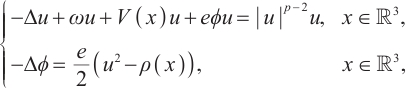 provided that
  and
and 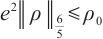 with
with  small enough, where
  ,
,  denotes a coupling constant,
  is a Lagrange multiplier, the potential
  is coercive and the doping profile
  satisfies appropriate decay conditions. The introduction of
  compromises the coercivity of the energy functional. Therefore, we establish the existence of ground state solutions by considering the minimization problem on Nehari manifold.
摘要
本文利用变分方法研究了当满足条件 且
且 (
( 为足够小的常数)时下述非线性薛定谔-泊松系统基态解的存在性:
 其中
其中 ,
, 为耦合常数,
 为拉格朗日乘子,势函数
 具有强制性,掺杂分布
 满足适当的衰减条件。
 的引入破坏了能量泛函的强制性。因此,本文通过考虑奈哈里流形上的极小化问题来研究基态解的存在性。
Key words: doping profile / ground state solution / Nehari manifold / variational methods
关键字 : 掺杂分布 / 基态解 / 奈哈里流形 / 变分法
Cite this article: HAO Xiaodong, HUANG Shuibo, ZHANG Huanhuan. Existence of Ground State Solutions to Nonlinear Schrödinger-Poisson System with Doping Profile and Coercive Potential[J]. Wuhan Univ J of Nat Sci, 2026, 31(3): 281-290.
Biography: HAO Xiaodong, male, Master candidate, research direction: partial differential equations. E-mail: This email address is being protected from spambots. You need JavaScript enabled to view it.
Foundation item: Supported by the National Natural Science Foundation of China (12361026) and the Discipline Construction Fund Project of Northwest Minzu University
© Wuhan University 2026
 This is an Open Access article distributed under the terms of the Creative Commons Attribution License (https://creativecommons.org/licenses/by/4.0), which permits unrestricted use, distribution, and reproduction in any medium, provided the original work is properly cited.
0 Introduction
In this paper, we investigate the following nonlinear Schrödinger-Poisson system
 (1)
(1)
where  appears as a Lagrange multiplier,
  is the potential function satisfying assumptions:

The doping profile  satisfies assumptions:

for 
The presence of the potential  significantly influences the functional-analytic framework. If
  is non-radial, unbounded or exhibits complex decay, the compactness of Sobolev embeddings may be compromised, hindering the verification of critical points. Furthermore, if
  tends to negative infinity or possesses deep potential wells, the energy functional may become unbounded below, necessitating additional constraints on
  to ensure well-posedness.
The nonlinear Schrödinger equation arises in quantum mechanics, nonlinear optics and other fields[1]. As an important extension, the Schrödinger-Poisson system combines the interplay between quantum mechanics and electromagnetism, providing a more accurate description of charged particle motion in electromagnetic fields, see Refs. [2-4].
We first review relevant results for the case  and
and Consider the system
 (2)
(2)
Ruiz[5] proved that there exists a positive radial solution to problem (2) with Lagrange multiplier  provided
  . He further showed that no nontrivial solutions exist if
  . Similar equations have been studied in Refs. [6-8].
When 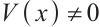 and
and  , the following nonlinear Schrödinger-Poisson system
 (3)
(3)
has been extensively studied. Specifically, for the coercive potential 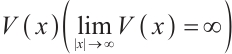 , Jiang et al[9] demonstrated that problem (3) admits a ground state solution when
  provided that the coupling constant
  is small enough. In the case where
  with
with
 , Jiang and Zhou[10] established the existence of a ground state solution to problem (3) with
  . Furthermore, in Ref. [11], they studied the existence of positive solutions to problem (3) with

Similarly, Azzollini and Pomponio[12] investigated the following nonlinear Schrödinger-Maxwell equations
 (4)
(4)
They proved that when  is a positive constant, problem (4) admits a ground state solution provided
  . For a nonconstant potential
  , they showed problem (4) admits a ground state solution under appropriate conditions on
  provided
  . For other relevant studies on the existence of solutions to nonlinear Schrödinger equations involving potential functions, see Refs. [13-19].
When 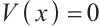 and
and  , Shan et al[20] investigated the following nonlinear Schrödinger-Newton system
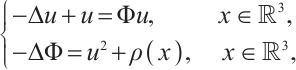 (5)
(5)
where 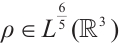 is a doping profile. They demonstrated that problem (5) admits a positive ground state solution if
  and
and  is small enough.
Recently, based on Ref. [7], Colin and Watanabe[21] investigated the following nonlinear Schrödinger-Poisson system
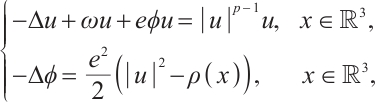 (6)
(6)
where  and
and  . They showed that problem (6) admits a ground state solution provided that there exists
  (independent of
  and
and  ) such that

Furthermore, Colin and Watanabe[22] studied the existence of stable standing waves to problem (6) in the case of  .
.
It is noteworthy that investigations involving both the doping profile  and the potential
  remain relatively scarce. Motivated by relevant studies[9,12,21], the main purpose of this paper is to establish the existence of ground state solutions to problem (1). We employ variational methods, constructing an energy functional and analyzing its critical points via the Mountain Pass Lemma[23] and the Palais-Smale condition[24].
Define

equipped with the inner product and norm
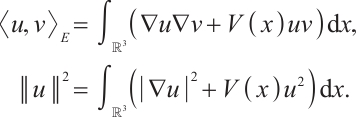 (7)
(7)
The energy functional associated with (1) is given by
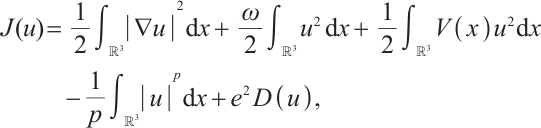 (8)
(8)
where  is defined as
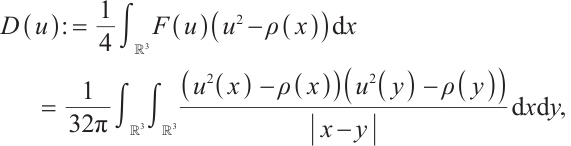 (9)
(9)
the nonlocal term  is defined as
 (10)
(10)
where
 (11)
(11)
 (12)
(12)
Definition 1 We say that  is a ground state solution to system (1) if
  has a least energy among all nontrivial solutions of (1), namely
 satisfies
 (13)
(13)
The following is the main result of this paper.
Theorem 1 Assume that  ,
,  satisfies
 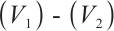 and
and  satisfies
 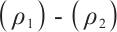 . Then system (1) admits a ground state solution provided that there exists a small enough constant
  such that
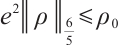 (14)
(14)
Remark 1 The coexistence of  and
and  complicates proving the Palais-Smale condition and Mountain Pass Lemma. Specifically, in verifying the Palais-Smale condition, although the coercivity of
  is employed to overcome the lack of compactness on
  , the nonlocal terms introduced by
  may disrupt this compactness if
  is too large. Hence, the smallness condition
 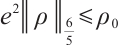 is crucial to the variational framework.
Remark 2 When  , there are contradictions in proving the Palais-Smale condition and the Mountain Pass Lemma. Therefore, we only consider the case where
  .
.
The paper is organized as follows: In Section 1, we present the necessary preliminary knowledge for subsequent proofs, including the decomposition of the energy functional, estimates of nonlocal terms, scaling properties of nonlocal terms and derivation of Nehari identity and Pohožaev identity. Section 2 is devoted to the proof of our main result. We first verify the boundedness of the functional and the Palais-Smale condition, then employ the Mountain Pass Lemma to prove the existence of a ground state solution (Theorem 1).
1 Preliminaries
The main purpose of this section is to present some lemmas and theorems required for the subsequent analysis, which closely follows the framework established in Refs. [21-22].
Firstly, rewrite the energy functional  in the following way:
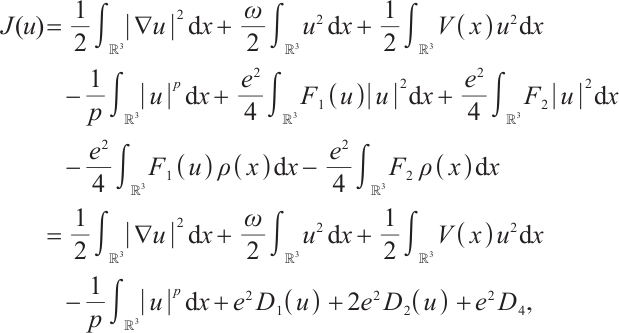
where 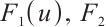 are defined by (11) and (12) respectively and
 (15)
(15)
 (16)
(16)
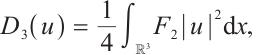 (17)
(17)
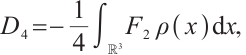 (18)
(18)
 (19)
(19)
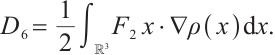 (20)
(20)
Obviously, by (11) and (12),
 (21)
(21)
The following lemma is devoted to present some estimates for the nonlocal terms in functional  .
.
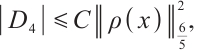
Lemma 1 For any  (i=1, 2, 4, 5, 6) satisfy the following estimates:
 (22)
(22)
 (23)
(23)
 (24)
(24)
 (25)
(25)
 (26)
(26)
 (27)
(27)
 (28)
(28)
Proof The proofs of (22), (24) and (25) can be found in Lemma 2.2 in Ref. [21]. The proofs of (23), (26), (27) and (28) can be found in Lemma 2.1 in Ref. [22].
We derive the scaling properties of the nonlocal terms  and
and  , which is essential in the subsequent proof of the Pohožaev identity.
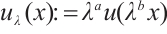
For  and
and  , denote
  .
.
Recall that

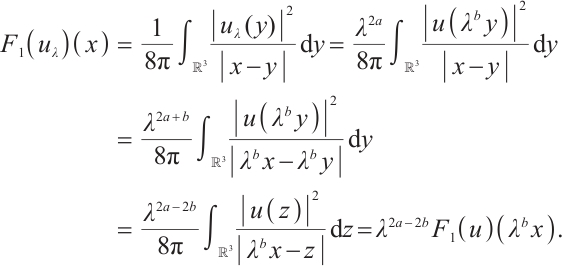
Let  , we have
 (29)
(29)
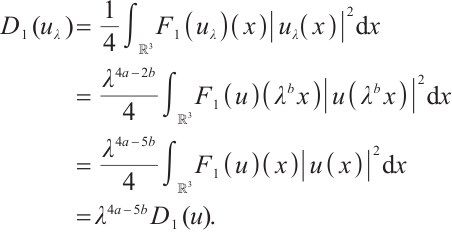
Thus
 (30)
(30)
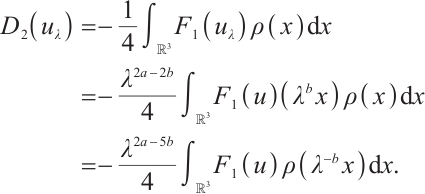
Similarly,
 (31)
(31)
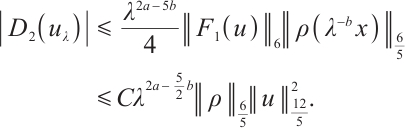
By the Hölder inequality and (22), it follows that
 (32)
(32)
In order to prove the existence of solutions, we establish the Nehari identity and the Pohožaev identity associated with (1).
Lemma 2[21] Suppose  is a solution to problem (1). Then
  satisfies the Nehari identity
 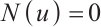 and the Pohožaev identity
  , where
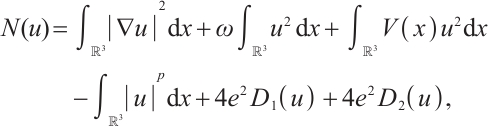 (33)
(33)
and
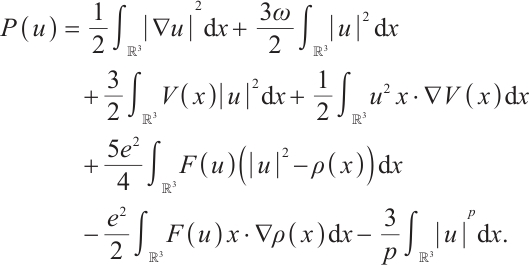 (34)
(34)
Proof Firstly, observe that, for any  ,
,
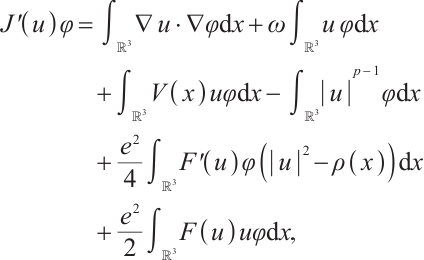 (35)
(35)
where  is defined by (10).
For any  , by the definition of
  , we have
 (36)
(36)
It is easy to check that, for any  ,
,
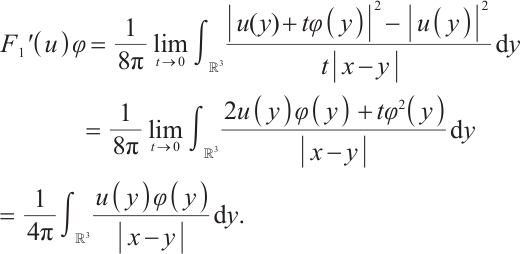 (37)
(37)
Therefore
 (38)
(38)
Thus, by (21) and (38), we obtain
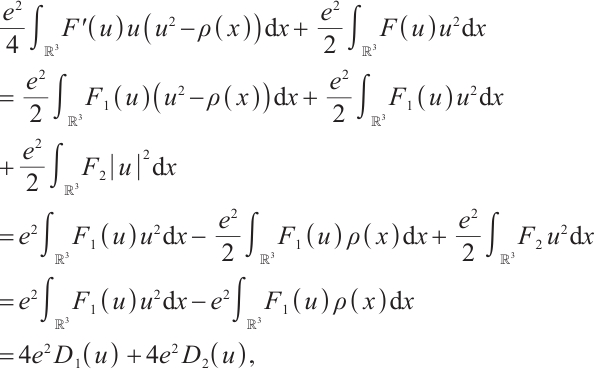
which leads to (33) holds.
Now, prove (34) by argument similarly as in Refs. [21,25].
Consider 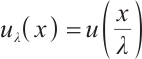 with
with  and
and  . Then, from (30) and (31), we deduce that
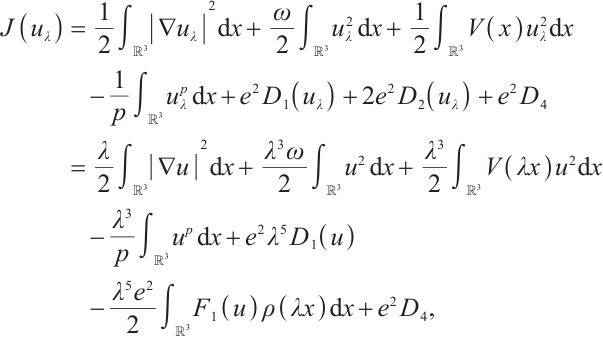 (39)
(39)
where  are defined by (15), (16) and (18) respectively.
By  and (39), it follows that
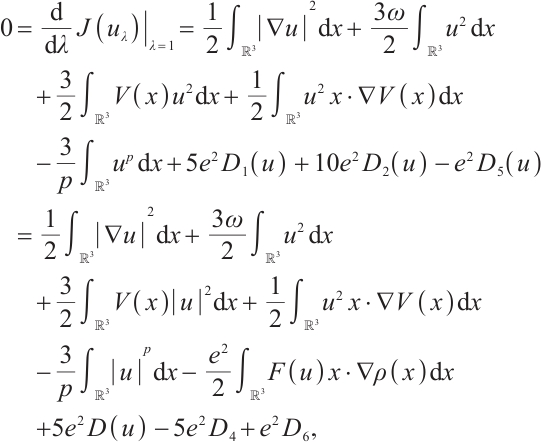 (40)
(40)
where 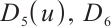 are defined by (19) and (20) respectively, which we use the fact that

Denote

By the definition of  (see (12)) and integration by parts, we have

Thus
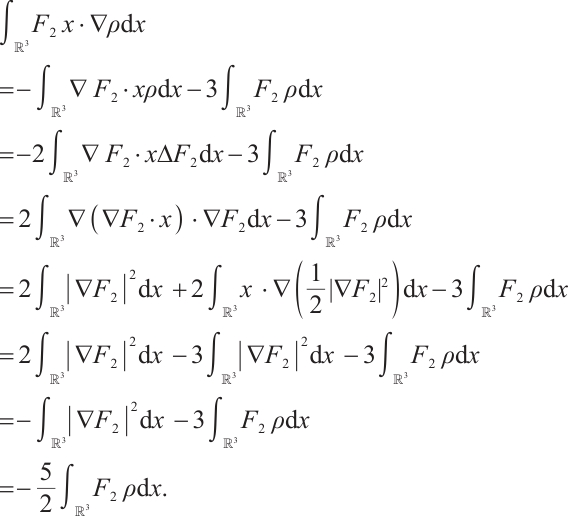
We deduce that . Using (40), we obtain (34).
Theorem 2[26] Let  be a real Banach space with its dual space
  and suppose that
 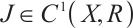 satisfies
 (41)
(41)
for some 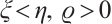 and
and  with
with  . Let
. Let  be characterized by
 (42)
(42)
where  is the set of continuous paths joining 0 and
  . Then there exists a sequence
  such that
 (43)
(43)
2 Proof of Theorem 1
In this section, we investigate the existence of ground state solutions when  and provide the proof of Theorem 1.
Definition 2 Let be a real Banach space and
  be a Fréchet differentiable functional, and its Fréchet derivative denoted by
 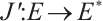 (where
  is the dual space of
  ). The Nehari manifold associated with the energy functional
  is defined as follows

In order to establish our result, we adopt the following approach: we seek the minimizer of functional (8) constrained to the Nehari manifold

where
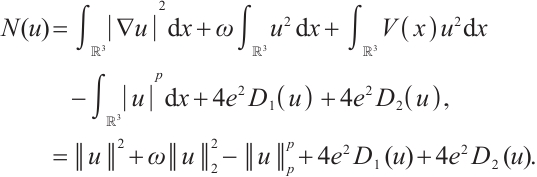 (44)
(44)
Lemma 3[12] Assume that 
 satisfies
 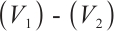 and
and  satisfies
 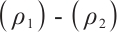 . Then the following hold:
ⅰ) For any  , there exists a unique number
  such that
  and
and 
ⅱ) there exists a positive constant , such that for all
ⅲ)  is a
is a  manifold,
provided that (14) holds with  small enough.
Proof Assertions ⅰ) and ⅱ) follow from standard arguments (see Ref. [27]). We now prove ⅲ).
For any  , observe that
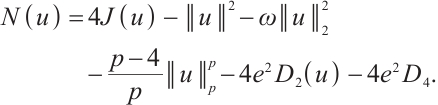
By (14), (25) and assertion ⅱ), for any  , we have

which we use the fact that 
Choose  small enough such that
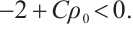
Thus, it follows that

The Nehari manifold  is a natural constraint for the functional
  . Therefore, we only need to seek critical points of
  on
on  .
.
Now, denote the ground state energy of system (1) by
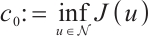
Lemma 4 Assume that  ,
,  satisfies
  and
and  satisfies
 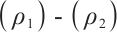 Then there exists constant
  such that for any
  ,
,
 (45)
(45)
provided that (14) holds with  small enough.
Proof Since  , observe that
 (46)
(46)
Combining with (46) and using (14) and (25), we obtain
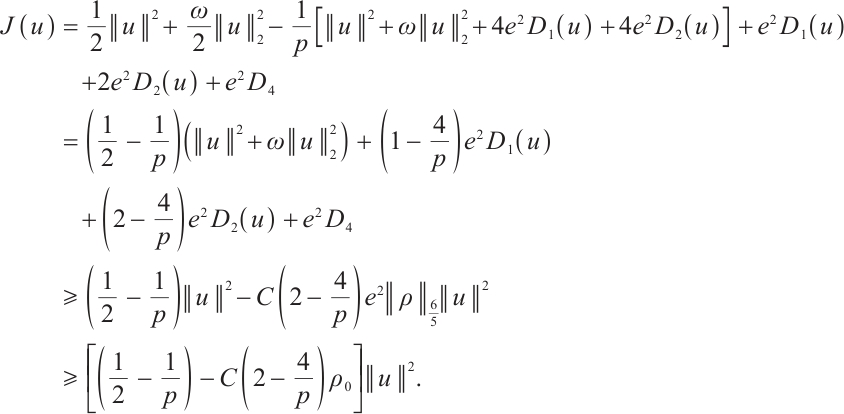 (47)
(47)
Now, choose  small enough such that
 (48)
(48)
Substituting (48) into (47) yields
 (49)
(49)
which completes the proof of (45).
Lemma 5 Assume that  ,
,  satisfies
 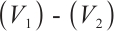 and
and  satisfies
 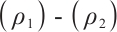 . Then there exists constant
  such that
 (50)
(50)
provided that (14) holds with  small enough.
Proof It follows from Ref. [9] that the embedding  is continuous. According to the embedding result in Ref. [15], we derive that
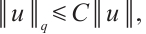 (51)
(51)
where  .
.
From (14), (25) and (51), it follows that
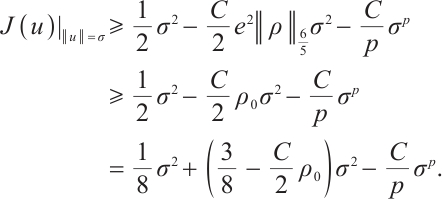 (52)
(52)
We now choose the constant  small enough such that
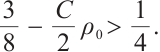
By (52), we get
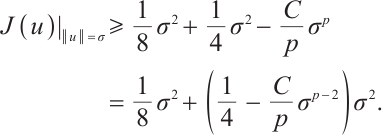 (53)
(53)
Fix  , choose
  small enough such that
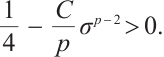
Consequently
 (54)
(54)
which completes the proof of (50).
Lemma 6 (Energy tends to negative infinity) Assume that  .
.  satisfies
 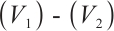 and
and  satisfies
 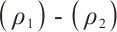 . Then there exists
 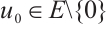 , such that

Proof Fixing 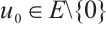 , then
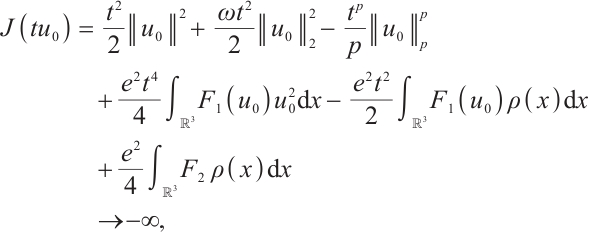
as  , since
  .
.
Theorem 3 Assume that  ,
,  satisfies
 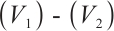 and
and  satisfies
 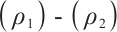 , then the energy functional
  satisfies the Palais-Smale (PS) condition in
  ; that is, any sequence
  satisfying
 (55)
(55)
admits a strongly convergent subsequence provided that (14) holds with  small enough.
Proof The proof is divided into four steps.
Step 1 Firstly, we prove that  is bounded in
 .
.
Let  satisfy
 (56)
(56)
By (25), (33) and (14), we have
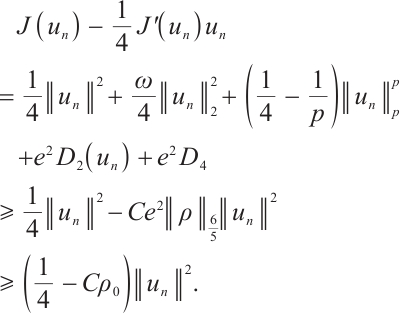
Choose  small enough such that
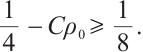
Consequently

Therefore, the sequence  is bounded in
  . By the embedding
  is continuous, then the sequence is also bounded in
  .
.
Step 2 Compactness analysis. Since  is bounded in
  and the embedding
 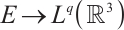 is compact for
  . Therefore, there exists a subsequence (still denoted by
  ) such that
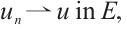
and
 (57)
(57)
Step 3 Non-local term convergence. We now establish the convergence of the nonlocal terms  and
and  . The argument for
  is analogous to that for
  . Thus, we give the detailed proof for
  only.
only.
By (22), the mapping  is continuous.
Applying (57) together with the Hölder inequality yields
 (58)
(58)
Combining (58) and the Hölder inequality, we deduce
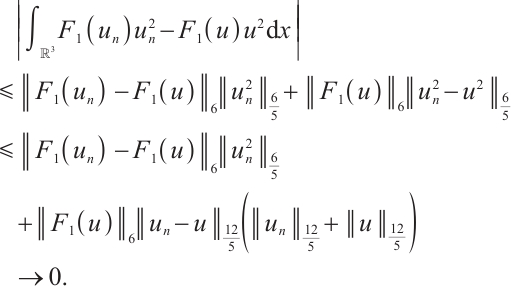
Recalling the definition of  (see (15)), it follows that
 (59)
(59)
By a similar argument, we have
 (60)
(60)
Step 4 Strong convergence verification. We now prove that  in
in  . From the Palais-Smale condition
  and
and  in
in  , we have
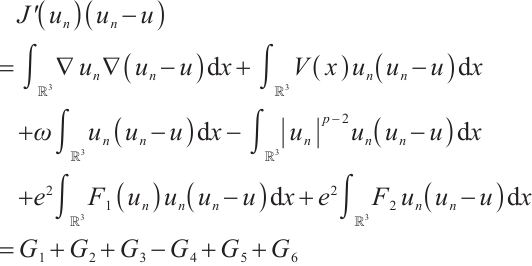
 (61)
(61)
We proceed to analyze each term in the expansion of 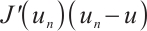 separately.
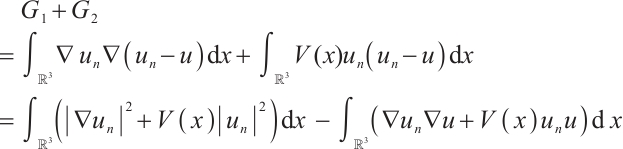
 (62)
(62)
where  denotes the inner product in
  .
.
 (63)
(63)
By (57) and Hölder inequality, we have
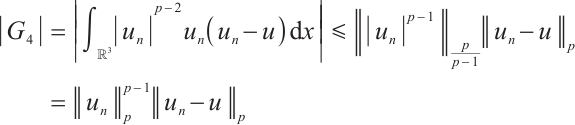
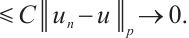 (64)
(64)
Similarly, applying the Hölder inequality together with (57) and (59), we obtain
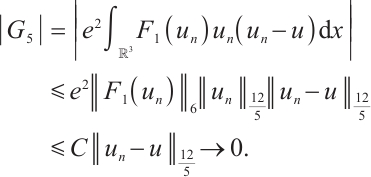 (65)
(65)
An analogous argument, by (57), (60) and Hölder inequality, yields
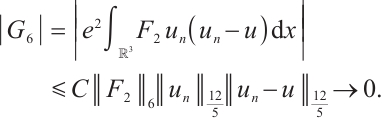 (66)
(66)
Substituting the above results into (61), we get
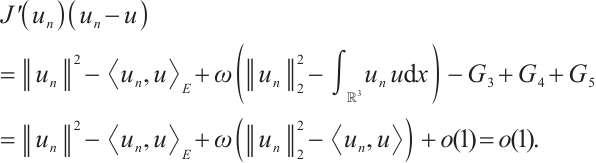 (67)
(67)
Since  in
in and
and  in
in  for
for  , it follows that
 (68)
(68)
Substituting (68) into (67) yields
 (69)
(69)
By the weak lower semicontinuity of norms
 (70)
(70)
From (69) and (70), it follows that the following conditions hold

Consequently
 (71)
(71)
Therefore,  in
in  , combined with the continuity of the embedding
 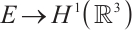 , which implies
  in
in  .
.
Theorem 4 Assume that  .
.  satisfies
  and
and  satisfies
 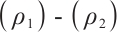 . Then system (1) admits aground state solution provided that there exists a small enough constant
  such that (14) holds.
Proof By Lemma 5, there exist constants  small enough and
  , such that
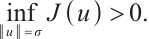
By Lemma 6, there exists  , such that

Define for large enough
 , we get

Thus,  satisfies the mountain pass geometric structure.
Define the mountain-pass level
 (72)
(72)
where 
By the Mountain Pass Lemma (Theorem 2), there exists a sequence  such that

Since  satisfies Palais-Smale condition, there exists
  such that
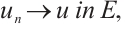
By the continuity of  and
and  , we have

Consequently,  is a critical point of
  .
.
We now prove that  .
.
By contradiction, suppose that , it follow that

By (26) and (14), we get

Now choose small enough such that
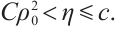
Consequently

which is a contradiction. Therefore, is nontrivial critical point.
Following the proof approach of Theorem 1.4 in Ref. [12], we show that  is a ground state solution.
Take a minimizing sequence 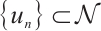 , such that
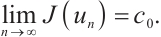 (73)
(73)
By (73), we may assume (see Ref. [28]) that is a Palais-Smale sequence for
  Consequently, it follows directly that
 is a Palais-Smale sequence for
  . Since
  satisfies the Palais-Smale condition (Theorem 3), there exists
 such that
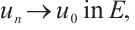 (74)
(74)
combined with the continuity of  ,
,  implies that

so .
.
Consequently, by (73) and (74), we get

then  is a ground state solution of system (1).
It is noteworthy that  (see Lemma 2.8 in Ref. [12]). For the proof concerning the existence of ground state solutions, we also refer the reader to Lemma 2.4 in Ref. [20].
In conclusion, by Lemma 5 and Lemma 6, energy functional  satisfies the conditions of the Mountain Pass Lemma. By the Palais-Smale condition (Theorem 3), there exists a critical point
  , which is a non-trivial solutions of the system, then the ground state solution can be obtained by Theorem 4.
References
- Carles R. Remarks on nonlinear Schrödinger equations with harmonic potential[J]. Annales Henri Poincaré, 2002, 3(4): 757-772. [Google Scholar]
- Benci V, Fortunato D. Solitons in Schrödinger-Maxwell equations[J]. Journal of Fixed Point Theory and Applications, 2014, 15(1): 101-132. [Google Scholar]
- Kaiser H C, Rehberg J. About a one-dimensional stationary Schrödinger-Poisson system with Kohn-Sham potential[J]. Zeitschrift für Angewandte Mathematik und Physik (ZAMP), 1999, 50(3): 423-458. [Google Scholar]
- Mauser N J. The Schrödinger-Poisson-Xα equation[J]. Applied Mathematics Letters, 2001, 14(6): 759-763. [Google Scholar]
- Ruiz D. The Schrödinger-Poisson equation under the effect of a nonlinear local term[J]. Journal of Functional Analysis, 2006, 237(2): 655-674. [Google Scholar]
- Benguria R, Brezis H, Lieb E H. The Thomas-Fermi-von Weizsäcker theory of atoms and molecules[J]. Communications in Mathematical Physics, 1981, 79(2): 167-180. [Google Scholar]
- Colin M, Watanabe T. Standing waves for the nonlinear Schrödinger equation coupled with the Maxwell equation[J]. Nonlinearity, 2017, 30(5): 1920-1947. [Google Scholar]
- Lieb E H. Thomas-Fermi and related theories of atoms and molecules[J]. Reviews of Modern Physics, 1981, 53(4): 603-641. [Google Scholar]
- Jiang Y S, Wang Z P, Zhou H S. Positive solutions for Schrödinger-Poisson-Slater system with coercive potential[J]. Topological Methods in Nonlinear Analysis, 2021, 57: 427-439. [Google Scholar]
- Jiang Y S, Zhou H S. Schrödinger-Poisson system with steep potential well[J]. Journal of Differential Equations, 2011, 251(3): 582-608. [Google Scholar]
- Jiang Y S, Zhou H S. Schrödinger-Poisson system with singular potential[J]. Journal of Mathematical Analysis and Applications, 2014, 417(1): 411-438. [Google Scholar]
- Azzollini A, Pomponio A. Ground state solutions for the nonlinear Schrödinger-Maxwell equations[J]. Journal of Mathematical Analysis and Applications, 2008, 345(1): 90-108. [Google Scholar]
- Abdullah Qadha S, Chen H B, Qadha M A. Existence of ground state solutions for choquard equation with the upper critical exponent[J]. Fractal and Fractional, 2023, 7(12): 840. [Google Scholar]
- Azzollini A. The planar Schrödinger-Poisson system with a positive potential[J]. Nonlinearity, 2021, 34(8): 5799-5820. [Google Scholar]
- Du M. Positive solutions for the Schrödinger-Poisson system with steep potential well[J]. Communications in Contemporary Mathematics, 2023, 25(10): 2250056. [Google Scholar]
- Meng Y X, Zhang X R, He X M. Ground state solutions for a class of fractional Schrodinger-Poisson system with critical growth and vanishing potentials[J]. Advances in Nonlinear Analysis, 2020, 10(1): 1328-1355. [Google Scholar]
- Peng X Q, Rizzi M. Normalized solutions of mass supercritical Schrödinger-Poisson equation with potential[J]. Calculus of Variations and Partial Differential Equations, 2025, 64(5): 152. [Google Scholar]
- Ruiz D, Vaira G. Cluster solutions for the Schrödinger-Poisson-Slater problem around a local minimum of the potential[J]. Revista Matemática Iberoamericana, 2011, 27(1): 253-271. [Google Scholar]
- Zhong X X, Zou W M. A new deduction of the strict sub-additive inequality and its application: Ground state normalized solution to Schrödinger equations with potential[J]. Differential and Integral Equations, 2023, 36(1/2):133-160. [Google Scholar]
- Shan L Y, Shuai W, Ye J H. Existence of positive solution for Schrödinger-Newton system with a doping profile[J]. Calculus of Variations and Partial Differential Equations, 2025, 65(1): 25. [Google Scholar]
- Colin M, Watanabe T. Ground state solutions for Schrödinger-Poisson system with a doping profile[EB/OL]. [2025-10-15]. https://arXivpreprintarXiv:2411.02103. [Google Scholar]
- Colin M, Watanabe T. Stable standing waves for nonlinear Schrödinger-Poisson system with a doping profile[J]. Nonlinearity, 2025, 38(11): 115019. [Google Scholar]
- Vu N. Mountain pass theorem and nonuniformly elliptic equations[J]. Vietnam J Math, 2005, 33: 391-402. [Google Scholar]
- Gordon W B. Physical variational principles which satisfy the Palais-Smale condition[J]. Bulletin of the American Mathematical Society, 1972, 78(5): 712-716. [Google Scholar]
- Cazenave T. Semilinear Schrödinger Equations[M]. Providence, Rhode Island: American Mathematical Society, 2003. [Google Scholar]
- Ekeland I. Convexity Methods in Hamiltonian Mechanics[M]. Berlin: Springer-Verlag, 1990. [Google Scholar]
- Rabinowitz P H. On a class of nonlinear Schrödinger equations[J]. Zeitschrift für Angewandte Mathematik und Physik (ZAMP), 1992, 43(2): 270-291. [Google Scholar]
- Willem M. Progress in Nonlinear Differential Equations and Their Applications[M]. Boston: Birkhäuser, 1996. [Google Scholar]
Current usage metrics show cumulative count of Article Views (full-text article views including HTML views, PDF and ePub downloads, according to the available data) and Abstracts Views on Vision4Press platform.
Data correspond to usage on the plateform after 2015. The current usage metrics is available 48-96 hours after online publication and is updated daily on week days.
Initial download of the metrics may take a while.