


| Issue |
Wuhan Univ. J. Nat. Sci.
Volume 31, Number 3, June 2026
|
|
|---|---|---|
| Page(s) | 291 - 298 | |
| DOI | https://doi.org/10.1051/wujns/2026313291 | |
| Published online | 24 June 2026 | |
Mathematics
CLC number: O211.6
Several Properties of Branching Processes with Migration and Affected by Viral Infectivity in Random Environments
随机环境中具有迁移且受病毒传染性影响的分枝过程的若干性质
School of Mathematics and Statistics, Suzhou College, Suzhou 234000, Anhui, China
(宿州学院 数学与统计学院,安徽 宿州 234000)
† Corresponding author. E-mail: This email address is being protected from spambots. You need JavaScript enabled to view it.
Received:
3
February
2025
Abstract
In this paper, a model of branching processes with migration and affected by viral infectivity in independent and identically distributed (i.i.d.) random environments is established firstly. Then the Markov property, conditional probability generating function and conditional expectation of the model are studied. Finally, under certain conditions, some sufficient conditions for certain extinction of processes are given, and some related theories of branching processes in random environments are generalized.
摘要
本文首先建立了独立同分布随机环境中具有迁移且受病毒传染性影响的分枝过程的模型。然后,研究了该模型的马氏性、条件概率母函数和条件期望的性质。最后,在一定条件下给出过程必然灭绝的一些充分条件,从而推广了随机环境中分枝过程的相关理论。
Key words: random environments / viral infectivity / migration / branching processes / conditional probability generating function / extinction probability
关键字 : 随机环境 / 病毒传染性 / 迁移 / 分枝过程 / 条件概率母函数 / 灭绝概率
Cite this article: REN Min, ZHANG Guanghui. Several Properties of Branching Processes with Migration and Affected by Viral Infectivity in Random Environments[J]. Wuhan Univ J of Nat Sci, 2026, 31(3): 291-298.
Biography: REN Min, female, Associate professor, research direction: probability theory and mathematical statistics. E-mail: This email address is being protected from spambots. You need JavaScript enabled to view it.
Foundation item: Supported by the National Natural Science Foundation of China (11971034) and the Natural Science Foundation of Anhui Universities (2022AH051370, 2023AH052234)
© Wuhan University 2026
 This is an Open Access article distributed under the terms of the Creative Commons Attribution License (https://creativecommons.org/licenses/by/4.0), which permits unrestricted use, distribution, and reproduction in any medium, provided the original work is properly cited.
0 Introduction
Branching process is a mathematical model used to describe the reproduction of species, which has received much attention. As the reproduction of species is subject to factors such as natural environment and social environment, many mathematicians have improved the classical branching process model. Smith and Wilkison first proposed branching processes in random environments and studied the extinction probability of branching processes in independent and identically distributed (i.i.d.) random environments and some properties of branching processes in Markovian environments[1-3]. Athreya and Karlin[4-5] discussed the extinction probability and some limiting behaviors of branching processes in stationary ergodic random environments. Holzheimer[6] introduced the controlled branching model in a random environment and studied its extinction probability. Yanev et al[7] investigated the sufficient condition for certain extinction and non-certain extinction of controlled branching processes in i.i.d. random environments; Bi et al[8] proposed a criterion for certain extinction of controlled branching processes in stationary ergodic random environments. Li et al[9] studied the Markov property and some limiting behaviors of controlled branching processes in random environments. Branching process with migration in random environments was first introduced by Key[10]. Li et al[11] discussed the conditional expectations and Markov property of branching processes with migration in random environments; Ren et al[12] studied the limiting behaviors of branching processes with migration in random environments. Li[13] investigated the asymptotic behavior for critical branching processes with migration. Wang et al[14] studied the limit theory for a supercritical branching process; Ren et al[15-16] studied the Markov property and limiting behaviors of the branching process affected by viral infectivity in a random environment, and the Markov property, conditional probability generating function and sufficient condition for certain extinction of bisexual branching processes influenced by viral infectivity in random environments. There have been many research results on the branching process in random environments, which can be seen in Refs. [17-21]. On the basis of Refs [12,15], the Markov property, conditional probability generating function, conditional expectation and sufficient condition for certain extinction of branching processes with migration and affected by viral infectivity in random environments are considered in this paper. Also, the existing correlation theory of branching process in random environments is generalized.
The remainder of this paper is organized as follows. In Section 1, some notations, definitions are introduced. Sections 2-4 are devoted to presenting the main results, including the Markov property, probability generating functions, conditional expectation and extinction probability. Section 5 is the conclusion.
1 Preliminaries
The model we shall be concerned with in this paper may be described as follows.
Let  be a given probability space,
  be a measurable space, and


Let 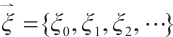 be a sequence of i.i.d. random variables, mapping from
  to
to  and Let
  and
and  denote two random variable sequences from
  to
to 
For any  we assume
  and
and 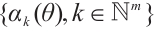 are two sequences of probability distributions, satisfying
 and there exists
  such that
Definition 1 Suppose  and
and 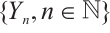 are two sequences of random variables mapping from
  to
to  and
and  to
to  , respectively and satisfy
(i) 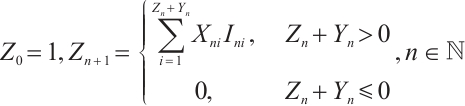 ;
;
(ii) 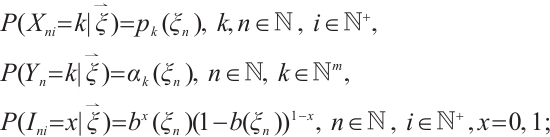
(iii) For given  ,
,  and
and 
are both independent sequences;  and
and
 are mutually independent. For fixed
  ,
,  are identically distributed. For fixed
  ,
,  and
and 
 are independent respectively.
Then 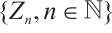 is called a branching process with migration and affected by viral infectivity in random environment
The above  represents the total number of individuals in n-th generation and the number of individuals migrated in n-th generation, respectively;
  represents the number of individuals in (n+1)-th generation produced by the i-th individual in n-th generation. We suppose
  when the i-th individual in n-th generation was infected and not cured, that is, it produces no offspring;
  when the i-th individual in n-th generation didn't have the virus or was cured of it, that is, it can reproduce normally.
2 Markov Property
Since the branching process is a special case of Markov chain in random environments, the branching process in random environments can be studied with the help of the theory of Markov chain. Therefore, we first discuss the Markov property of branching processes with migration and affected by viral infectivity in random environments.
Definition 2 Suppose  and
and  are random sequences from
  to
to  and
and  , respectively. For any
  , if
, if
 (1)
(1)
 (2)
(2)
then  is called a Markov chain in random environment
  . For ease of exposition, we introduce some notations. Set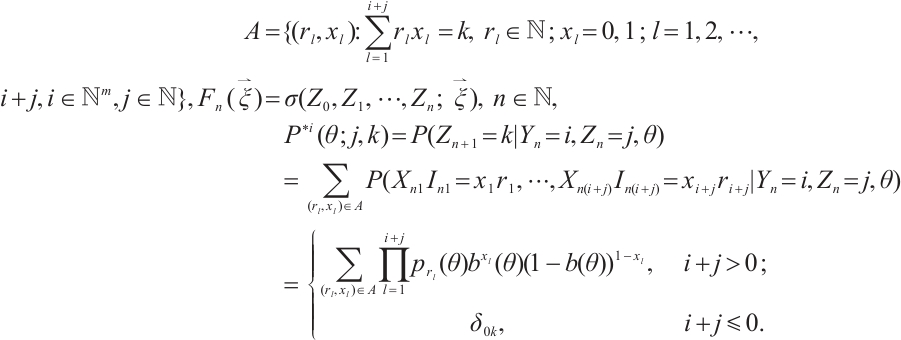
Theorem 1 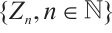 is a Markov chain in random environment
  with the one-step transition probabilities
Proof By Definition 2, to prove  is a Markov chain in random environment
  , it suffices to prove that (1) and (2) hold.
By  we have (1) holds. Next we prove (2) and it suffices to show, for any
  , it follows that
 (3)
(3)
Since  and
and  are measurable with respect to
  , it suffices to show, for any
 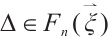 , it follows that
 (4)
(4)
Taking 
 (where
  ),
),
we proceed to the proof of (4). We suppose  (if
(if  , let
, let  and
and  ).
).
Writing 
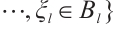 , we get

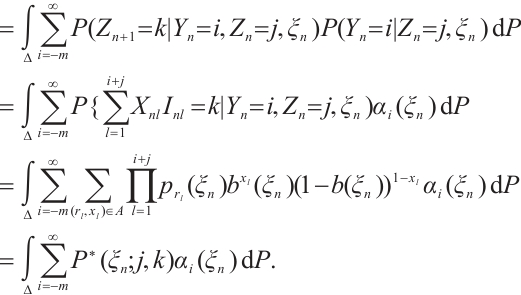
Using the independence assumed in Definition 1 (iii) and the properties of conditional expectation, it is deduced that
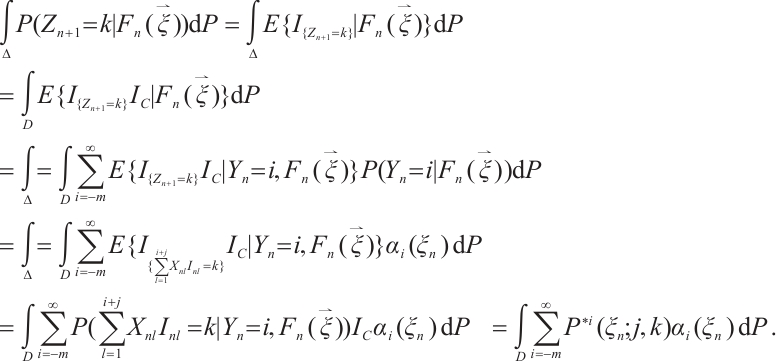
Therefore, (4) holds, that is,  is a Markov chain in random environment
  with the one-step transition probabilities claimed above.
3 Conditional Probability Generating Function and Conditional Expectation
Since the extinction probability and martingale convergence of branching process in random environments are often investigated from the conditional probability generating function and conditional expectation of the process, in what follows, we consider the conditional probability generating function and conditional expectation of branching process with migration and affected by viral infectivity in random environments.
For convenience, we give some notations. Writing
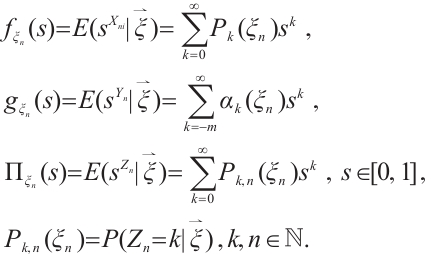
Theorem 2 For any  it follows that
 (5)
(5)
Proof From Definition 1, the definition of  and properties of conditional expectation, we obtain
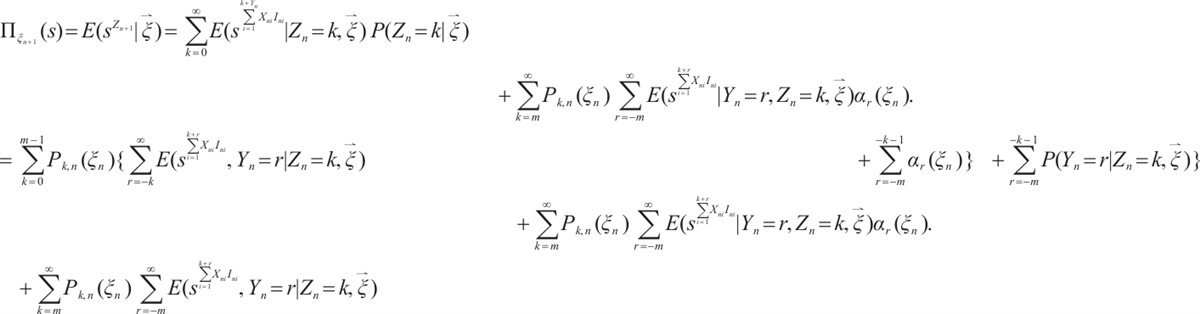
Since for  are independent, so we have

Hence,
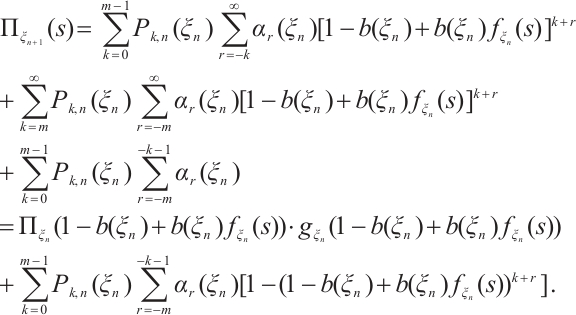
This completes the proof.
Corollary 1 For any  it follows that


Proof From  , we have
  Using the recursion of (5), we obtain
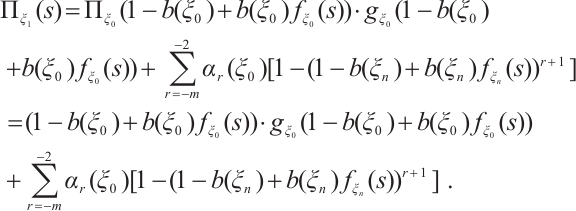
Applying the recursion of Theorem 2, we then have
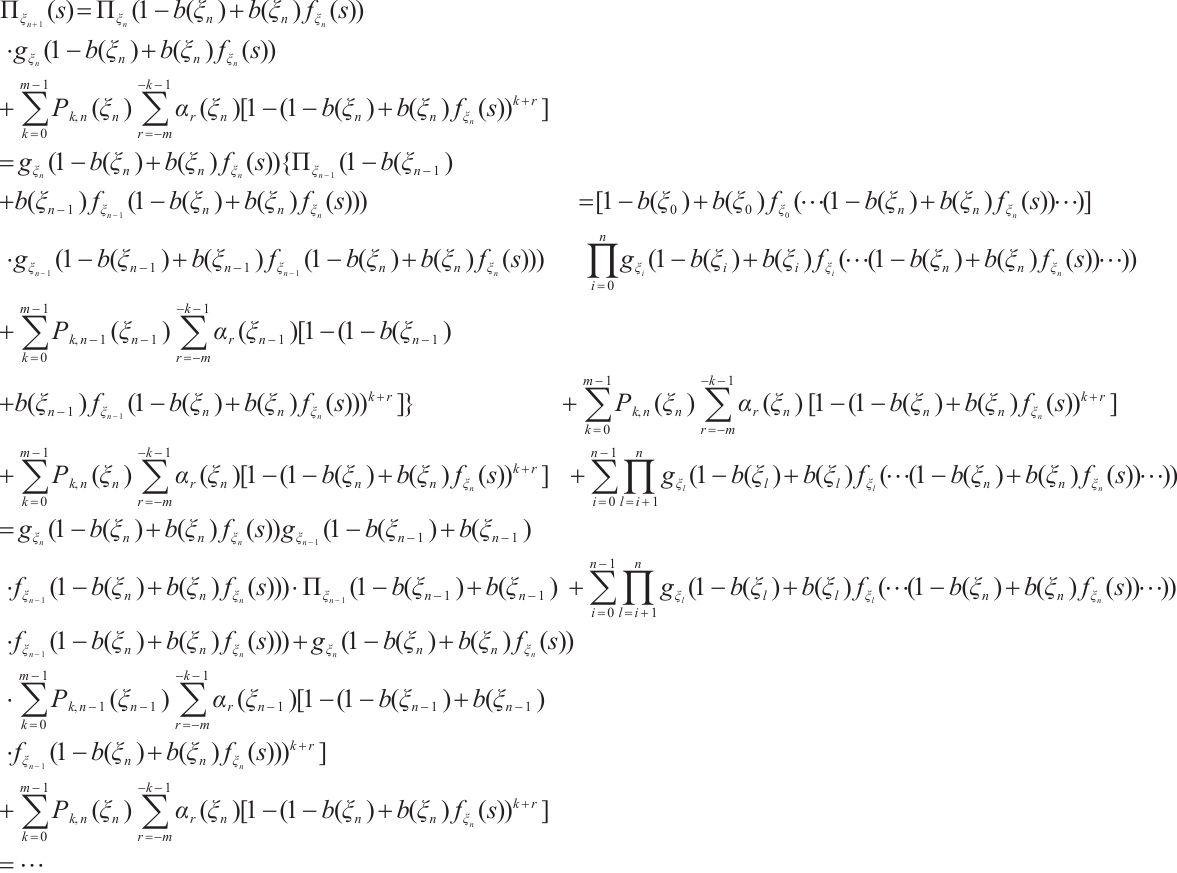
This proof is completed.
Theorem 3 For any  , it follows that

Proof Taking the derivatives on both sides of (5) gives

Moreover,
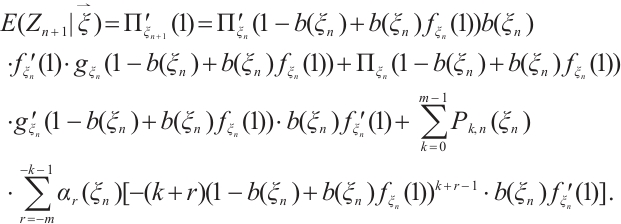
Due to  then for any
  , we can deduce that
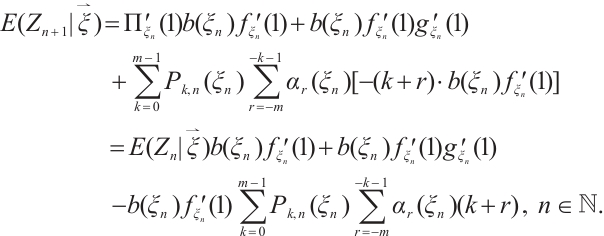
The proof is completed.
Corollary 2 For any  , it follows that
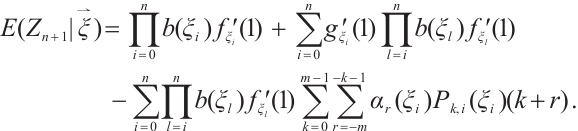
Proof Applying the recursion of Theorem 3, we have
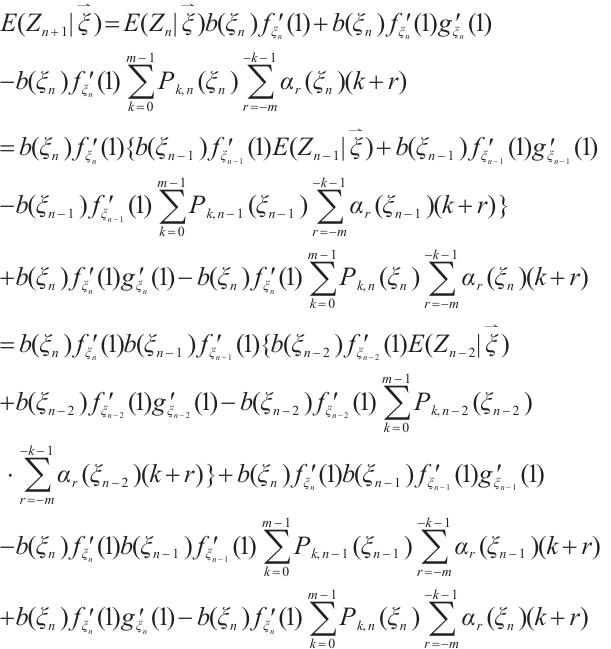
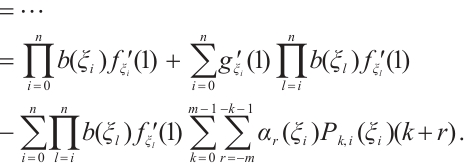
This completes the proof.
4 Extinction Probability
Definition 3 Let 
 and
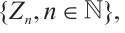
and  are defined to be the conditional extinction probability and extinction probability of process
  respectively. Process
  is called to be certainly extinct, if there exists
  such that
  . Otherwise, process
 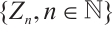 is called to be non-certainly extinct.
Lemma 1 For any state  , Markov Chain
 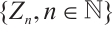 is transient, if for any
 holds, where
Proof For any  it follows that

By the condition  , we can deduce that for any
  ,
, 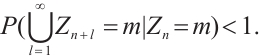 Namely
  in state
  is transient. Therefore,for any
  , it holds that
  ,and
,and 
Theorem 4 If for any  it follows that
  , where
 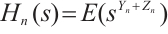 and there exists
  such that, for any
  ,
,  , then for every
  ,
,  is certainly extinct, i.e., for every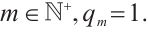
Proof By Lemma 1, to prove  it suffices to prove that for any
 From Ref. [19], we derive that for any
  , it follows that

Let  Next we prove
  Take
Take  and let
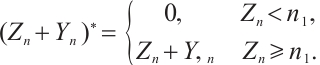
Constructing an auxiliary process

If  , then
  Hence,
 (6)
(6)
For any  it follows that

By Lemma 1, for every  , when
  is sufficiently large, for any
  , it holds that
 (7)
(7)
By Chebyshev's inequality, one can derive

By the assumption that for every  ,
, holds, we have
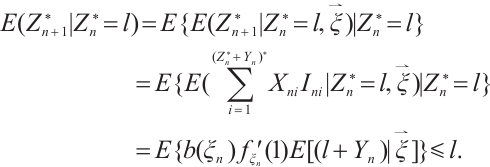
Consequently,
 (8)
(8)
By (7) and (8), we obtain that for every  , there exists sufficiently large
  such that

Hence, for any  ,
,  whenever
  and
and  are sufficiently large. Therefore,
  , which implies
  i.e.,
i.e.,  This completes the proof.
Theorem 5 Suppose 1) For any  , it holds
  , where
 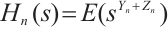 ; 2) There exists a sequence of i.i.d. random variables
 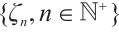 such that
 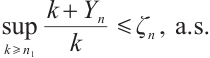 Moreover,
 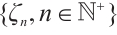 and each of the set
are independent. Then if  , we can conclude that
 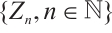 is certainly extinct, i.e.,
  for all
Proof To start with, consider the case  . Using Jensen's inequality gives

On the other hand, for any  using the condition
  yields

By Theorem 4, we obtain  , i.e.,
 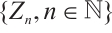 is certainly extinct.
Now we turn to the case

Let  be the auxiliary process constructed in Theorem 4, then for
  , it follows that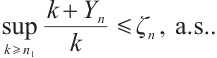
Denote a sequence of random variable by

then 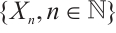 is i.i.d.. Let
 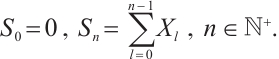 Since
Since  , then
  . Meanwhile,
  then for any
  , there exists non-negative integer stopping time
  , where
Suppose  Below we prove that for any
  , it follows that
 (9)
(9)
In fact,

Namely, (9) holds for  Assuming (9) holds for
 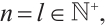 we will prove it holds for
  . By the independence of
  and
and  , we obtain

Therefore, (9) holds for any  We proceed to prove that

In fact, since 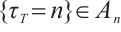 , then
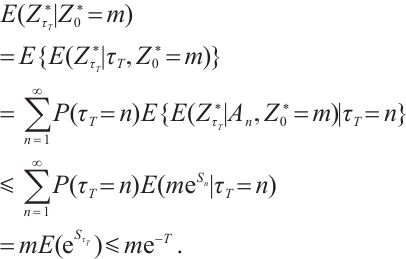
Combining Chebyshev's inequality, we have  . When
  is sufficient large, it follows that

then, 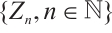 is of certain extinction.
5 Conclusion
In this paper, we mainly studied the property of Markov, probability generating function and conditional expectation of branching process with migration and affected by viral infectivity in random environments, and the sufficient conditions for certain extinction of processes. The theory of branching process in random environments is generalized. In future, we shall study the limit theory of the process such as large deviation, laws of the iterated logarithm, and some properties of branching processes affected by viral infectivity in independent non-identically random environment and stationary ergodic random environment.
References
- Smith W L. Necessary conditions for almost sure extinction of a branching process with random environment[J]. The Annals of Mathematical Statistics, 1968, 39(7): 2136-2140. [Google Scholar]
- Smith W L, Wilkinson W E. On branching processes in random environments[J]. The Annals of Mathematical Statistics, 1969, 40(3): 814-827. [Google Scholar]
- Smith W L, Wilkinson W E. Branching processes in Markovian environments[J]. Duke Mathematical Journal, 1971, 38(4): 749-763. [Google Scholar]
- Athreya K B, Karlin S. On branching processes with random environments I: Extinction probabilities[J]. The Annals of Mathematical Statistics, 1971, 42(5): 1499-1520. [Google Scholar]
- Athreya K B, Karlin S. On branching processes with random environments II: Extinction probabilities[J]. The Annals of Mathematical Statistics, 1971, 42(6): 184-185. [Google Scholar]
- Holzheimer J. φ-Branching processes in a random environment[J]. Applicationes Mathematicae, 1983, 18(3): 351-358. [Google Scholar]
- Yanev G P, Yanev N M. Extinction of controlled branching processes in random environments[J]. Mathematica Balkanica, New Series, 1990, 4(6): 368-380. [Google Scholar]
- Bi Q X, Li J F. Controlled branching processes in random environments[J]. Journal of Mathematics, 2003, 23(4): 437-442(Ch). [Google Scholar]
- Li Y Q, Li D R, Pan S, et al. Limit theorems for controlled branching processes in random environments[J]. Acta Mathematica Sinica, Chinese Series, 2018, 61(2): 317-326(Ch). [Google Scholar]
- Key E S. Limiting distributions and regeneration times for multitype branching processes with immigration in a random environment[J]. The Annals of Probability, 1987, 15(1): 344-353. [Google Scholar]
- Li Y Q, Liu Q S. Branching processes with migration in random environments[J]. Journal of Xiangtan University (Natural Science Edition), 2009, 31(3): 18-22(Ch). [Google Scholar]
- Ren M, Wang J J. Limiting behaviors of the bisexual branching processes with migration in random environments[J]. Journal of Jilin Institute of Chemical Technology, 2020, 37(11): 85-90(Ch). [Google Scholar]
- Li D D, Zhang M. Asymptotic behaviors for critical branching processes with immigration[J]. Acta Mathematica Sinica, English Series, 2019, 35(4): 537-549. [Google Scholar]
- Wang Y Q, Liu Q S. Limit theorems for a supercritical branching process with immigration in a random environment[J]. Science China Mathematics, 2017, 60(12): 2481-2502(Ch). [Google Scholar]
- Ren M. Limit properties for branching process affected by communicable diseases in random environments[J]. Journal of Zhejiang University (Science Edition), 2022, 49(1): 53-59(Ch). [Google Scholar]
- Ren M, Wang J J, Wang Y P. Probability generating functions and extinction conditions for the bisexual branching process affected by infectivity of virus in random environments[J]. Journal of Wuhan University (Natural Science Edition), 2021, 67(3): 263-269(Ch). [Google Scholar]
- Sun W, Liu W, Li D R. Limit properties for branching process with immigration in random environment[J]. Mathematical Theory and Applications, 2013, 33(4): 1-5(Ch). [Google Scholar]
- Wang Y Q, Liu Q S. Berry-Esseen's bound for a supercritical branching process with immigration in a random environment[J]. Scientia Sinica Mathematica, 2021, 51(5): 751-762(Ch). [Google Scholar]
- Zubkov A M. Analogies between Galton-Watson processes and branching processes[J]. Theory of Probability & Its Applications, 1975, 19(2): 309-331. [Google Scholar]
- Ren M, Zhang G H. Some properties of branching processes with random control functions and affected by viral infectivity in random environments[J]. Advances in Continuous and Discrete Models, 2023, 2023(1): 1-18. [Google Scholar]
- Song M Z, Wu Y F. Complete convergence for moving average processes under m-WOD random variables[J]. Wuhan University Journal of Natural Sciences, 2024, 29(6): 529-538. [Google Scholar]
Current usage metrics show cumulative count of Article Views (full-text article views including HTML views, PDF and ePub downloads, according to the available data) and Abstracts Views on Vision4Press platform.
Data correspond to usage on the plateform after 2015. The current usage metrics is available 48-96 hours after online publication and is updated daily on week days.
Initial download of the metrics may take a while.