


| Issue |
Wuhan Univ. J. Nat. Sci.
Volume 30, Number 1, February 2025
|
|
|---|---|---|
| Page(s) | 60 - 68 | |
| DOI | https://doi.org/10.1051/wujns/2025301060 | |
| Published online | 12 March 2025 | |
Mathematics
CLC number: O177
Property
 and Property
 for Operator and Its Functions
算子及算子函数的
 性质与
性质与
 性质
性质
1 School of Mathematics and Statistics, Weinan Normal University, Weinan 714099, Shaanxi, China
2 School of Mathematics and Statistics, Shaanxi Normal University, Xi'an 710062, Shaanxi, China
Received:
18
April
2024
Abstract
By using the topological uniform descent, the necessary and sufficient conditions for which property  and property
  hold for bounded linear operators are given. As a consequence of the main result, the stability of property
  and property
  is studied, and a new judgement for operator functions that satisfy property
  and property
  is discussed.
摘要
本文运用拓扑一致降标性质,给出了有界线性算子同时满足 性质与
性质与 性质的充要条件。之后利用主要结论,研究了
 性质与
性质与 性质的稳定性,并得到了算子函数同时有
 性质与
性质与 性质的新判定方法。
Key words: property (WE) / property (R) / spectrum
关键字 : (WE)性质 / (R)性质 / 谱
Cite this article: SUN Chenhui, CAO Xiaohong. Property (WE) and Property (R) for Operator and Its Functions[J]. Wuhan Univ J of Nat Sci, 2025, 30(1): 60-68.
Biography: SUN Chenhui, female, Ph. D., Associate professor, research direction: operator theory. E-mail: sunchenhui1986@163. com
Foundation item: Supported by the 2021 General Special Scientific Research Project of the Education Department of Shaanxi Provincial Government (21JK0637), the Science and Technology Planning Project of Weinan Science and Technology Bureau (2022ZDYFJH-11) and the 2021 Talent Project of Weinan Normal University (2021RC16)
© Wuhan University 2025
 This is an Open Access article distributed under the terms of the Creative Commons Attribution License (https://creativecommons.org/licenses/by/4.0), which permits unrestricted use, distribution, and reproduction in any medium, provided the original work is properly cited.
0 Introduction
The Weyl type theorem of bounded linear operator can well reflect the structure characteristics and distribution of operator's spectral[1-5]. Therefore, the Weyl type theorem is an important topic in spectral theory. In recent years, the research scope of Weyl type theorems has been extended from general operators to operator functions, operator matrices, etc. Numerous significant results have been obtained[6-9]. Property  and property
  are the latest variations of Weyl type theorems, which have attracted the attention and research of operator theorists[10-12]. In this paper, by decomposing and constructing the operator spectrum and using the topological uniform scaling property, we give a new method for bounded linear operators and operator functions to satisfy the property
  and property
  . Furthermore, the perturbation of property
  and property
  is characterized, and the necessary and sufficient conditions for the operator function to have both the property
  and property
  are studied.
Throughout this paper,  denotes a complex separable infinite dimensional Hilbert space. Let
  be the algebra of all bounded linear operators on
  . For an operator
  we shall denote by
  the dimension of the kernel
  , and by
  the codimension of the range
  . We call
  is an upper semi-Fredholm operator if
  and
and  is closed. If
  is an upper semi-Fredholm operator and
  , we call
  a bounded below operator. If
 ,
,  is a lower semi-Fredholm operator. An operator
  is said to be Fredholm if
  is closed and both
  and
and  are finite. If
  is an upper (or a lower) semi-Fredholm operator, the index of
  ,
,  , is defined to be
 . The ascent of
  ,
,  , is the least non-negative integer
  such that
 and the descent,
  , is the least non-negative integer
  such that

 . We call
  a Drazin invertible operator if
 . The operator
  is Weyl if it is Fredholm of index zero, and
  is said to be Browder if it is Fredholm "of finite ascent and descent". Let
  be the spectrum of
  and
and  be the approximate point spectrum of
  . We write
  ,
,  ,
,  ,
,  ,
,  and
and  for the Weyl spectrum of
  , the Browder spectrum of
  , the essential spectrum of
  , the semi-Fredholm spectrum of
  , the essential approximate point spectrum of
  and the Browder essential approximate point spectrum of
  . Let
. Let 
 ,
, 
 ,
, 
 ,
, 
 ,
, 
 ,
, 
 (
( denotes the set of complex numbers).
  is called an isoloid operator if
 where
where 
 . For a set
  , we write
  ,
,  and
and  for the set of isolated points, accumulation points and boundary points set of
  . We denote by
  the set of all normal eigenvalues of
  , thus
  .
.  satisfies property
  if
if  , where
 [10].
[10].  satisfies property
  if
if  , where
  [10].
[10].
In this paper, we mainly study property  and property
  for bounded linear operators and its functions. Some meaningful conclusions are obtained.
1 Judgement of Property  and Property
  for Bounded Linear Operators
Although both property  and property
  are variations of Weyl's theorem based on their definitions, there is no necessary connection between them.
Remark 1 (i)  satisfies property

 satisfies property
  .
.
Let 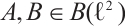 be defined by
  ,
,  . Suppose that
  . Then
  ,
,  ,
,  ,
,  .
.  satisfies property
  , but property
  does not hold for
  .
.
(ii)  satisfies property

 satisfies property
  .
.
Let  be defined by
  ,
,  ,
,  . We have that
  ,
,  .
.  . So
. So  satisfies property
  and
and  does not have property
  .
.
(iii)  has property
  and property

 and
and  .
.
Topological uniform descent is an important property of operators, which is widely used in spectral theory. If  , then for each nonnegative integer
  ,
,  induces a linear transformation from the vector space
  to
to  . We denote
  the dimension of the null space of the induced map and let
  . The following definition was introduced by Grabiner[13]. Let
  , if there is a nonnegative integer
  for which
  for
for  and
and  is closed in the operator range topology of
  for
for  , then we say that
  has topological uniform descent.
It can be shown that if  is upper semi-Fredholm, then
  has topological uniform descent. Let
  has topological uniform descent},
 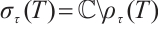 . Grabiner discovered many properties of topological uniform descent. We will use the following property (Ref. [13], Corollary 4.9): Suppose that
  ,
,  , if
, if  has topological uniform descent, then
  is a pole of
  . Next, we will discuss property
  and property
  by using the topological uniform descent.
Lemma 1 Let  , the following statements are equivalent:
(1)  satisfies property
  ;
;
(2)  ;
;
(3) 
Proof (1) (2). Suppose that
  satisfies property
  . If
. If 
 , then there exists a deleted neighborhood
  centered on
  such that for any
  ,
,  is a Weyl operator. Since
  has property
  , we know that
  is a Browder operator. Then we get that
  . We assume that
  . If
. If  , we get that
  is Drazin invertible. According to
  , we have
  . Since
  satisfies property
  , we can get that
  is a Browder operator. If
  , we can also get that
  and
and  is Browder operators. The inclusion "
 " is obviously true.
(2) (1). Since
  and
and 
 , we know that
  . Similarly,
 . Hence
  satisfies property
  .
.
The fact that  implies that (2)
 (3).
(3).
The closeness of operator range is very important in spectral theory. According to the closeness of operator range, the following spectral set is defined:  is not closed}.
Lemma 2 Let  , the following statements are equivalent:
(1)  satisfies property
  ;
;
(2) 
 ;
;
(3) 

Proof (1) (2). Suppose
 . Without loss of generality, we assume that
  . Then we have
  . There exists a deleted neighborhood
  centered on
  such that for any
  ,
,  . If
. If  , then
  . Since
  satisfies property
  , we have that
  is a Browder operator. Suppose that
  , if
, if  , then
  is an upper semi-Fredholm operator. By
  ,
,  and
and  , we know that
  . Because
  has property
  , we can get that
  . If
. If  , then exists a deleted neighborhood
  centered on
  such that for any
  ,
,  . Therefore
  . Since
  and
and  , we can also get that
  .
.
(2) (1). Suppose that
  . It follows that
 . So
. So  is a Browder operator. Then we have
  . Similarly, we can get the inclusion "
 ". Hence
  satisfies property
  .
.
If (2) holds, then  has property
  . This implies that
  , where
  . It follows that
 . Hence



 . Then we have that

The inclusion " " is obviously true. This implies that (3) holds. For the converse, if (3) holds, by
  we know that (2) holds. Therefore (2)
 (3).
(3).
Based on Lemma 1 and Lemma 2, the following results demonstrate that the two properties can be valid at the same time:
Theorem 1
 satisfies property
  and property
  if and only if
Proof " ". Suppose
  has property
  . Using Lemma 2, we have that
  Since
Since  has property
  , we know that
  Thus
Thus 
" ". By the condition, we get that
  The inclusion "
 " is obviously true. From Lemma 2, we know that
  satisfies property
  .
.
If  , then
  is a Browder operator,
  . The converse is similar. Therefore
  satisfies property
  .
.
Remark 2 (i) In Theorem 1, suppose  satisfies property
  and property
  , then each part of the decomposition of
  cannot be deleted.
( ) Let
) Let  be defined by
  . Hence
  has property
  and property
  . But
. But  Thus
Thus  cannot be deleted.
( ) Let
) Let  be defined by
  . Then
  has property
  and property
  . But
. But 

 . Thus
  cannot be deleted.
( ) Let
) Let  be defined by
  . We know that
  has property
  and property
  . But
. But 

 . Hence
  cannot be deleted.
( ) Let
) Let  be defined by
  ,
,  . And suppose
  . Then
  satisfies property
  and property
  . But
. But 


 . Therefore
  cannot be deleted.
( ) Let
) Let  be defined by
  ,
, 
 . And suppose
  . Thus
  satisfies property
  and property
  . But
. But 


 . It follows that
  cannot be deleted.
(ii) The conditions in Theorem 1 can be transformed as follows:  can be replaced by
  ,
,  can be replaced by
  .
.
From Lemma 1 and Lemma 2, we can get the following Corollary.
Corollary 1 Let  . Then:
(1)  satisfies property


 ;
;
(2)  satisfies property
By Theorem 1 and Corollary 1, we can get the following Corollary.
Corollary 2 Let  . Then
  satisfies property
  and property

Proof Using Theorem 1,  satisfies property
  and property

" ".
".  is obvious. If
 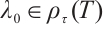 and
and 
 , by Theorem 1 we know that
  .
.
" ". Suppose
  and
and 
 . If
. If  , we have
  by the condition. Suppose
  , if
, if  , we can get that
  , then
  is a Browder operator. If
  , using
  we have
  . It also follows that
  . From Theorem 1, we can get that
  satisfies property
  and property
  .
.
2 The Perturbation of Property  and Property
Suppose  satisfies property
  or property
  and
and  is a compact operator or even a finite rank operator, but we cannot deduce that
  satisfies property
  or property
  . For example, let
  be defined by
  ,
, 
 . It is obviously that
  satisfies property
  and property
  and
and  is a finite rank operator. However, calculations indicate that
  does not satisfy either property
  or property
  .
.
The operator  is called a power finite rank operator, if there is a positive integer
  such that
  . A power finite rank operator is a Riesz operator, therefore, when
  is a power finite rank operator, operator
  is commutative with
  , then it has the following properties:
  , where
 and
and  [14].
[14].
Due to the complexity of general compact perturbations, this section focuses on the power finite rank perturbation of property  and property
  .
.
Lemma 3 Let  and
and  is a power finite rank operator with
  . The following statements are equivalent:
(1)  satisfies property
  and is an isoloid operator;
(2)  ;
;
(3)  .
.
Proof (1) (2). Since
  satisfies property
  and
and  ,
, 
 , we have that
  . If
. If  , when
  , by the proof of Lemma 1, we know that
  is Drazin invertible. Thus
  . If
. If  , then
  . Since
  has property
  , we get that
  is a Browder operator. It is a contradiction. Therefore
  , hence
  . By
. By  is Drazin invertible we have that
  . Suppose that
  . Without loss of generality, we assume that
  . Then
  . The fact that
  is isoloid implies that
  . Because
  has the property
  ,
,  is a Browder operator. We also have that
  .
.
(2) (1). Suppose that
  . Then we have that
  is a Weyl operator. So
  . By condition (2), we can get that
  is a Browder operator. Thus
  is a Browder operator. Then
  . Contrarily, if
  , then
 . Therefore
  . Hence
  and
and  are Browder operators.
If there exists  such that
  , then
  . By condition (2), we have that
  is a Browder operator. It follows that
  is a Browder operator. The fact that
  implies that
  is invertible, which is a contradiction. Therefore
  is an isoloid operator.
(1) (3). Suppose
  . If
. If  , from the proof of (1)
  (2) we can get that
  . If
. If 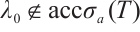 , we assume that
  without loss of generality. Since
  , we have that
  . Hence
  . Since
  is isoloid and satisfies property
  , we have that
  is a Browder operator. Thus
  .
.
(3) (1). The proof for (3)
 (1) is the same as the proof for (2)
 (1).
(1).
Lemma 4 Let  and
and  is a power finite rank operator with
  . The following statements are equivalent:
(1)  is an isoloid operator and satisfies property
  ,
,  ;
;
(2)  ;
;
(3) 
Proof (1) (2). Suppose
 . We assume that
  . If
. If 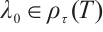 , when
  , we can get that
  . Then
  is a Browder operator. When
  , we have that
  is a Weyl operator. Hence
  . The fact that
  satisfies property
  implies that
  is a Browder operator. Hence
  . If
. If 
 , then
  . We can assume that
  . Since
  is an isoloid operator, we have that
  . Since
  satisfies property
  , we can get that
  is a Browder operator. Therefore
  .
.
(2) (1). Let's first prove that
  is an isoloid operator. If there exists
  such that
  . We assume that
  without loss of generality. Thus
  ,
,  . Therefore
 . It follows that
  is a Browder operator. Then
  is a Browder operator. Hence
  is invertible, which is a contradiction. Thus
  is an isoloid operator.
Next we will prove  . If
. If  , then
 . It implies that both
  and
and  are Browder operators. Hence
  .
.
If  , then
 . Hence
  and
and  are Browder operators. Thus
  . Conversely, suppose that
  , then
  . Then we also have that

 . Thus
  and
and  are Browder operators. Hence
  satisfies property
  .
.
The proof for (1) (3) is the same as the proof for (1)
 (2).
(2).
Then we obtain the finite rank perturbation with two properties held at the same time.
Theorem 2 Let  and
and  is a power finite rank operator with
  . The following statements are equivalent:
(1)  is an isoloid operator and satisfies property
  and property
  ,
, 
 ;
;
(2) 

Proof (1) (2). Suppose
 . If
. If  , by Lemma 4 we have that
  . If
. If  , by Lemma 3 we also get that
  .
.
(2) (1). The statement (2) implies that
  . Suppose
 , then
 . If
. If  , then
 . If
. If  , we have that
  . Thus
  is Drazin invertible. Therefore
 . Hence


 . Then
  is a Browder operator. Thus
 . With Lemma 3 we get that
  is isoloid and satisfies property
  .
.
By condition (2) we have that 

 . Then according to Lemma 4 we have that
  satisfies property
  and
and  . Therefore (1) holds.
3 Property  and Property
  for Operator Functions
Let  be the class of all complex-valued functions which are analytic on a neighborhood of
  and are not constant on any component of
  . For the function's properties, we discuss property
  first.
Lemma 5 Let  . For any
  ,
,  satisfies property
  if and only if
  ,
,  ,
,  and one of the following conditions holds:
(1)  ;
;
(2)  .
.
Proof " ". Suppose (1) holds. Then
  ,
,  , thus for any
  ,
,  ,
,  . Since
 , we have that
  . So
. So  satisfies property
  . If (2) holds, then
 ,
,  . Hence
  . It follows that
  . For the converse, let
  , and let
 , where
  , and
, and  is inverse. We assume that
  , then
 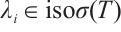 , thus
  . It follows that
  is a Browder operator.
" ". If there exists
  such that
  ,
,  , suppose that
  , then
  . By
. By  satisfies property
  , we have that
  is a Browder operator. Hence both
  and
and  are Browder operators. It is a contradiction. Thus
  ,
,  .
.
If  , then the fact that
  satisfies property
  implies that
  ,
,  . According to Lemma 1, we can get (1) holds. When
  , we can assert that
 . If not, suppose that
  ,
,  . Let
. Let  , then
  . Since
  satisfies property
  , then
  is a Browder operator, so is
  , which is a contradiction. Therefore
  . By Lemma 1 and its proof, we get that (2) holds.
Similarly, we can obtain the following conclusion. Let  , for any
  ,
,  satisfies property
  if and only if
  ,
,  and one of the following conditions holds:
(1) 
 ;
;
(2)  .
.
Corollary 3 Let  , for any
  ,
,  satisfies property
  if and only if
  ,
,  and the following conditions holds:
(1)  satisfies property
  ;
;
(2) If  , then
  .
.
For property  of operator functions, we have the following conclusions.
Lemma 6 Let  , for any
  ,
,  satisfies property
  if and only if one of the following conditions holds:
(1) 
 ;
;
(2)  .
.
Proof " ". If
". If  , then
  . By Lemma 2, we can get that (1) holds.
If  , we can assert that
  . If not, suppose that
  ,
,  , let
, let  , then
  . Since
  satisfies property
  , we can get that
  is a Browder operator. Then
  is a Browder operator, which is a contradiction. Therefore
  . Similarly, we have
  in this situation. Suppose that
  . If
. If 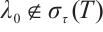 , by
, by  satisfies property
  and
and  we have that
  . The fact that
  implies that
  is a Browder operator. If
  , we can assume that
  . Since
 , we have
  . By
. By  has property
  , we can get that
  is a Browder operator. Therefore (2) holds.
" ". If condition (1) holds, then
  ,
,  ,
,  . Then for any
 ,
,  . Hence
  . Since
  , we have that
  . Therefore
  satisfies property
  .
.
If conditions (2) holds, then  ,
,  ,
, 
 . Hence
  . Suppose that
  . Let
. Let 
 , where
  ,
,  is invertible. We can assume that
  , then
  . Since
  has property
  , we get
  . So
. So 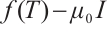 is a Browder operator. Therefore
  satisfies property
  .
.
By the proof of Lemma 6, we can get that:
Corollary 4 Let  . For any
  ,
,  satisfies property
  if and only if the following conditions holds:
(1)  satisfies property
  ;
;
(2) If  , then
  .
.
Then we obtain the condition that the operator function satisfies both two properties.
Theorem 3 Let  . For any
  ,
,  satisfies property
  and property
  if and only if
  ,
,  and:
and:
(1)  satisfies property
  and property
  ;
;
(2) If  , then
  .
.
Proof " ". According to Corollary 3 and Corollary 4, we know that we only need to prove (2). Suppose that
  . If
. If  , by Corollary 3 we know that
  is a Browder operator. Suppose
  . When
  , by Corollary 4 we can get that
  . When
  , the fact that
  implies
  . Thus
  . We also get that
  is a Browder operator. The converse is obviously true. Hence (2) holds.
The sufficiency is easy to get from Corollary 3 and Corollary 4.
Corollary 5 Let  . For any
  ,
,  satisfies property
  and property
  if and only if
 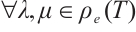 ,
,  and one of the following conditions holds:
(1) 

 ;
;
(2)  .
.
Proof " ". If
". If  , then
  . Since
 , by Theorem 1 and Remark 2 we can get that (1) holds. If
  , the condition (2) hold.
" ". According to Theorem 1 and Theorem 3, we know that for any
  ,
,  satisfies property
  and property
  .
.
Example 1 Let  be defined by:
  ,
, 
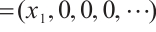 . Suppose that
  . Then: (1)
  satisfies property
  and property
  ; (2) For any
  ,
,  ; (3)
; (3)  , and
, and  .
.
Therefore by Theorem 3, we can get that for any  ,
,  satisfies property
  and property
  .
.
References
- Djordjević D S. Operators obeying a-Weyl's theorem[J]. Publicationes Mathematicae Debrecen, 1999, 55(3/4): 283-298. [CrossRef] [MathSciNet] [Google Scholar]
- Cao X H, Guo M Z, Meng B. Weyl spectra and Weyl's theorem[J]. Journal of Mathematical Analysis and Applications, 2003, 288(2): 758-767. [CrossRef] [MathSciNet] [Google Scholar]
- Gupta A, Kumar A. Properties (BR) and (BgR) for bounded linear operators[J]. Rendiconti Del Circolo Matematico Di Palermo Series 2, 2020, 69(2): 601-611. [CrossRef] [MathSciNet] [Google Scholar]
- Sun C H, Wang N, Cao X H. Topological uniform descent and judgement of a-Weyl's theorem [J]. Wuhan University Journal of Natural Sciences, 2023, 28(5): 392-398. [CrossRef] [EDP Sciences] [Google Scholar]
- Aiena P, Triolo S. Weyl-type theorems on Banach spaces under compact perturbations[J]. Mediterranean Journal of Mathematics, 2018, 15(3): 126. [CrossRef] [Google Scholar]
- Wu X F, Huang J J, Chen A. Weylness of 2 × 2 operator matrices[J]. Mathematische Nachrichten, 2018, 291(1): 187-203. [CrossRef] [MathSciNet] [Google Scholar]
- Dong J, Cao X H, Dai L. On weyl's theorem for functions of operators[J]. Acta Mathematica Sinica, English Series, 2019, 35(8): 1367-1376. [CrossRef] [MathSciNet] [Google Scholar]
- Dai L, Yi J L. Property (ω) and Hypercyclic Property for Operators[J]. Wuhan University Journal of Natural Sciences, 2024, 29(6): 499-507. [CrossRef] [EDP Sciences] [Google Scholar]
- Zhu S, Li C G, Zhou T T. Weyl type theorems for functions of operators [J]. Glasgow Mathematical Journal, 2012, 54(3): 493-505. [CrossRef] [MathSciNet] [Google Scholar]
- Berkani M, Kachad M. New Browder and weyl type theorems[J]. Bulletin of the Korean Mathematical Society, 2015, 52(2): 439-452. [CrossRef] [MathSciNet] [Google Scholar]
- Yang L L, Cao X H. Property (R) for functions of operators and its perturbations[J]. Mediterranean Journal of Mathematics, 2022, 19(1): 25. [CrossRef] [Google Scholar]
-
Ren Y X, Jiang L N, Kong Y Y. Property
 and topological uniform descent [J]. Bulletin of the Belgian Mathematical Society - Simon Stevin, 2022, 29(1): 1-17.
[MathSciNet]
[Google Scholar]
and topological uniform descent [J]. Bulletin of the Belgian Mathematical Society - Simon Stevin, 2022, 29(1): 1-17.
[MathSciNet]
[Google Scholar]
- Grabiner S. Uniform ascent and descent of bounded operators[J]. Journal of the Mathematical Society of Japan, 1982, 34(2): 317-337. [CrossRef] [MathSciNet] [Google Scholar]
- Rakočević V. Semi-Browder operators and perturbations[J]. Studia Mathematica, 1997, 122(2): 131-137. [CrossRef] [MathSciNet] [Google Scholar]
Current usage metrics show cumulative count of Article Views (full-text article views including HTML views, PDF and ePub downloads, according to the available data) and Abstracts Views on Vision4Press platform.
Data correspond to usage on the plateform after 2015. The current usage metrics is available 48-96 hours after online publication and is updated daily on week days.
Initial download of the metrics may take a while.