


| Issue |
Wuhan Univ. J. Nat. Sci.
Volume 30, Number 3, June 2025
|
|
|---|---|---|
| Page(s) | 231 - 234 | |
| DOI | https://doi.org/10.1051/wujns/2025303231 | |
| Published online | 16 July 2025 | |
Mathematics
CLC number: O156.1
A Note on a Class of Permutation Quadrinomials of Fq2
有限域上一类置换四项式的注记
1 School of Mathematics and Big Data, Chongqing University of Education, Chongqing 400065, China
2 School of Mathematical Sciences, Chongqing Normal University, Chongqing 401331, China
† Corresponding author. E-mail: This email address is being protected from spambots. You need JavaScript enabled to view it.
Received:
15
July
2024
Abstract
Constructing permutation polynomials is a hot topic in finite fields, and permutation polynomials have many applications in different areas. In this paper, by using monomials on the cosets of a subgroup to characterize the permutational property of rational functions on  , we construct a class of permutation quadrinomials with the form
  of
of  .
.
摘要
构造置换多项式是有限域上的一个热点问题,置换多项式在诸多领域都有应用。本文利用 的子群陪集上的单项式来刻画
 上有理函数的置换性质,构造了一类有限域
 上形如
上形如 的置换四项式。
Key words: permutation quadrinomials / monomials / finite fields
关键字 : 置换四项式 / 单项式 / 有限域
Cite this article: QIN Xiaoer, GUO Xiaonan, QIU Yinuo, et al. A Note on a Class of Permutation Quadrinomials of Fq2[J]. Wuhan Univ J of Nat Sci, 2025, 30(3): 231-234.
Biography: QIN Xiaoer, male, Ph.D., research direction: number theory. E-mail: This email address is being protected from spambots. You need JavaScript enabled to view it.
Foundation item: Supported by the National Natural Science Foundation of China (11926344), Science and Technology Research Program of Chongqing Municipal Education Commission (KJZD-K202401601), Doctor Talent Program of Chongqing University of Education (2023BSRC003) and Undergraduate Science Research Program of Chongqing University of Education (KY20240046)
© Wuhan University 2025
 This is an Open Access article distributed under the terms of the Creative Commons Attribution License (https://creativecommons.org/licenses/by/4.0), which permits unrestricted use, distribution, and reproduction in any medium, provided the original work is properly cited.
0 Introduction
Let  be the finite field with
  elements. A polynomial
 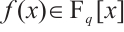 is called a permutation polynomial if
  induces a bijection from
  to itself. Permutation polynomials have wide applications in coding theory, cryptography and combinatorial designs. We refer the readers to Refs. [1-3] for more details of the recent advances.
Permutation polynomials with a few terms have attracted more attention in recent years for their simple algebraic forms and some special properties. There are several classes of permutation trinomials of the form  over
over  constructed in recent years. Kyureghyan and Zieve[4] described a class of permutation trinomials having the form
  of
of  , where
  is the trace function from
  to
to  . We note that this kind of permutation trinomials actually has the form
  . Zheng et al[5] showed a class of permutation trinomials of the form
  , where
 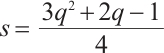 , which can be rewritten as
  . In Ref. [6], the authors got several classes of more generalized permutation trinomials having similar forms to
and  . By using a similar idea to Ref. [6], Lavorante[7] constructed a few new families of permutation trinomials with the form
  . By using monomial functions on the cosets of a subgroup of
  , Hou and Lavorante[8] gave a general method to construct permutation polynomials over
  . Specially, they presented several classes of permutation binomials and trinomials.
On the other hand, permutation quadrinomials also have attracted attention in recent years. Especially, constructing permutation quadrinomials of the form
 (1)
(1)
where  are integers, attracted great interest recently. Gupa[9] studied several classes of permutation quadrinomials of the form (1) over
  with
with 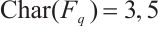 . Tu et al[10] proposed a class of permutation quadrinomials having the form
  of
of  . In Ref. [11], the authors investigated some permutation quadrinomials of
  with the case of
  in (1) under some restrictive conditions. In Ref. [12], the authors provided more classes of permutation quadrinomials of the form (1) in characteristic two. Lavorante[13] used the Hasse-Weil type theorems to prove the necessary conditions for a polynomial in Ref. [12] to be a permutation polynomial. Ding and Zieve[14] determined all permutation polynomials over
  having the form
  , where, for some
  which is the power of the character of
  , the terms of
  have degrees
  and
and  . The authors in Ref. [15] characterized two classes of permutation quadrinomials over
  by using self-reciprocal polynomials. In this paper, motivated by the method in Ref. [6], we continue to construct a new class of permutation quadrinomials of
  .
.
This paper is organized as follows: In Section 1, we list some results, which will be used in our paper. In Section 2, by using monomials of  and
and  , we construct a class of permutation quadrinomials over
  of the form
  for some integers
  .
.
1 Preliminary
The following result was discovered independently by several authors.
Lemma 1[16-17]
Let  be a positive integer. Then
  is a permutation polynomial of
  if and only if each of the following is true:
(1)  ,
,
(2)  permutes
  -th roots of unity
  .
.
Specially, by using Lemma 1, constructing permutation polynomials of the form  over
over  translates to finding permutations having the form
  on the set of
  -th roots of unity
  . For
. For  , one has

where  denotes the polynomial obtained
  by raising every coefficient to the
  -th power. Thus to show that
  permutes
  , the point is to prove that the rational function
 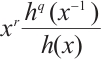 permutes
  .
.
Let  with
with  be a positive integer and
  be a primitive
  -th root of unity. We make some denotations:
  and
and  for
for  . It is easy to imply that
 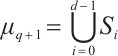 and
and 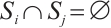 for
for  .
.
For 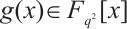 , if
, if  is a monomial on each subset of
  , then by using the piecewise method, we can easily determine the permutational property of
  on
on  in the following lemma.
Lemma 2[6] Let  be a positive integer and
  for
for  . For
. For 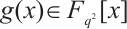 , if
, if

Then  permutes
  if and only if each of the following is true:


Lemma 2 provides an approach to study the permutational property of 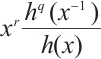 on
on  via monomials on the subsets
  . In Refs. [4,5,7], the authors used the case
  in Lemma 2 to construct a few classes of permutation trinomials of
  . By using the cases
  , the authors obtained several kinds of permutation trinomials of
  in Refs. [16,18].
2 Main Results
Motivated by the method in Ref. [6], we characterize several classes of permutation quadrinomials over  in this section.
Theorem 1 Let  be a prime power with
  , and
, and 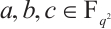 satisfy
 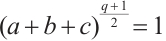 and
and 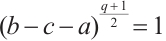 . Let
. Let  be a positive integer and
  be an even integer. Then
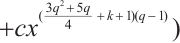 permutes
  if and only if
  and
and  .
.
Proof It follows from Lemma 1 that  permutes
  if and only if
  and
and  permutes
  , where
 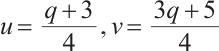 .
.
In the following, we claim that if  , then
  permutes
  if and only if
  .
.
We divide  into two subsets
  and
and  , and consider the following cases. For
  in
in  , it is easy to check that
  . One has
  .
.
Since  , we have that
  is odd. Then by
 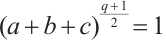 , we deduce that the equation
  has no roots in
  . Furthermore,

By using 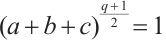 ,
,  can be simplified as
 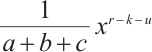 . Since
  can be written as
  for
for  and
and 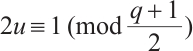 , thus
  can be rewritten as
 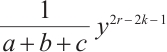 .
.
For  in
in  , one has
  . Then

Since  , we have that
  and
and  are odd, thus
  is odd. Then by
 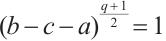 , we know that
  for
for  . Thus

Since 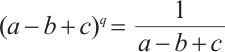 and
and 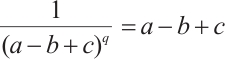 , then
 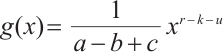 . For
. For  , there exists
  such that
  can be presented by
  . Then
 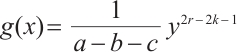 .
.
Note that 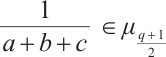 and
and 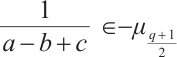 . Then it follows from Lemma 2 that
  permutes
  if and only if
  . Namely, the claim is true.
Therefore, we can conclude that  permutes
  if and only if
  and
and 
We complete the proof of Theorem 1.
Similarly, we can get the following results, and we omit their detailed proofs.
Theorem 2 Let  be a prime power with
  , and
, and 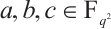 satisfy
 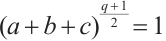 and
and 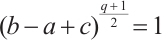 . Let
. Let  be a positive integer and
  be an even integer. Then
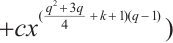 permutes
  if and only if
  and
and  .
.
Theorem 3 Let  be a prime power with
  , and
, and 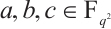 satisfy
 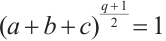 and
and 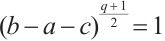 . Let
. Let  be a positive integer and
  be an even integer. Then
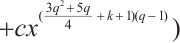 permutes
  if and only if
  and
and  .
.
Theorem 4 Let  be a prime power with
  , and
, and 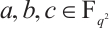 satisfy
 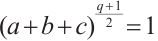 and
and 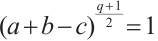 . Let
. Let  be a positive integer and
  be an even integer. Then
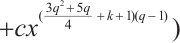 permutes
  if and only if

References
- Hou X D. Permutation polynomials over finite fields: A survey of recent advances[J]. Finite Fields and Their Applications, 2015, 32: 82-119. [Google Scholar]
- Li N, Zeng X Y. A survey on the applications of niho exponents[J]. Cryptography and Communications, 2019, 11(3): 509-548. [Google Scholar]
- Wang Q. Combinatorics and Finite Fields[M]. Berlin: De Gruyter, 2019. [Google Scholar]
- Kyureghyan G, Zieve M. Contemporary Developments in Finite Fields and Applications[M]. Singapore: World Scientific, 2016. [Google Scholar]
- Zheng D B, Yuan M, Yu L. Two types of permutation polynomials with special forms[J]. Finite Fields and Their Applications, 2019, 56: 1-16. [Google Scholar]
- Qin X E, Yan L. Constructing permutation trinomials via monomials on the subsets of μq+1[J]. Applicable Algebra in Engineering, Communication and Computing, 2021, 34(2): 321-334. [Google Scholar]
- Lavorante V P. New families of permutation trinomials constructed by permutations of μq+1[EB/OL]. [2023-2-15]. https://arxiv.org/abs/2105.12012. [Google Scholar]
-
Hou X D, Lavorante V. P. A general construction of permutation polynomials of
 [J]. Finite Fields Appl, 2023, 89: 102193.
[Google Scholar]
[J]. Finite Fields Appl, 2023, 89: 102193.
[Google Scholar]
- Gupta R. Several new permutation quadrinomials over finite fields of odd characteristic[J]. Designs, Codes and Cryptography, 2020, 88(1): 223-239. [Google Scholar]
-
Tu Z, Zeng X Y, Helleseth T. New permutation quadrinomials over
 [J]. Finite Fields Appl, 2018, 50: 304-318.
[Google Scholar]
[J]. Finite Fields Appl, 2018, 50: 304-318.
[Google Scholar]
- Tu Z R, Zeng X Y, Helleseth T. A class of permutation quadrinomials[J]. Discrete Mathematics, 2018, 341(11): 3010-3020. [Google Scholar]
- Zheng L J, Liu B X, Kan H B, et al. More classes of permutation quadrinomials from Niho exponents in characteristic two[J]. Finite Fields and Their Applications, 2022, 78: 101962. [Google Scholar]
- Pallozzi Lavorante V P. On permutation quadrinomials from Niho exponents in characteristic two[J]. Finite Fields and Their Applications, 2024, 96: 102418. [Google Scholar]
- Ding Z G, Zieve M E. Determination of a class of permutation quadrinomials[J]. Proceedings of the London Mathematical Society, 2023, 127(2): 221-260. [Google Scholar]
-
Brochero Martínez F E, Gupta R, Quoos L. Classification of some permutation quadrinomials from self reciprocal polynomials over
 [J]. Finite Fields and Their Applications, 2023, 91: 102276.
[Google Scholar]
[J]. Finite Fields and Their Applications, 2023, 91: 102276.
[Google Scholar]
- Akbary A, Wang Q. On polynomials of the form xrf(xq-1/l)[J]. Int J Math Math Sci, 2007, 2007: 23408. [Google Scholar]
- Wang Q. Cyclotomic mapping permutation polynomials over finite fields[C]//Sequences, Subsequences, and Consequences. Berlin: Springer-Verlag, 2007: 119-128. [Google Scholar]
-
Li K Q, Qu L J, Chen X, et al. Permutation polynomials of the form
 and permutation trinomials over finite fields with even characteristic[J]. Cryptography and Communications, 2018, 10(3): 531-554.
[Google Scholar]
and permutation trinomials over finite fields with even characteristic[J]. Cryptography and Communications, 2018, 10(3): 531-554.
[Google Scholar]
Current usage metrics show cumulative count of Article Views (full-text article views including HTML views, PDF and ePub downloads, according to the available data) and Abstracts Views on Vision4Press platform.
Data correspond to usage on the plateform after 2015. The current usage metrics is available 48-96 hours after online publication and is updated daily on week days.
Initial download of the metrics may take a while.